
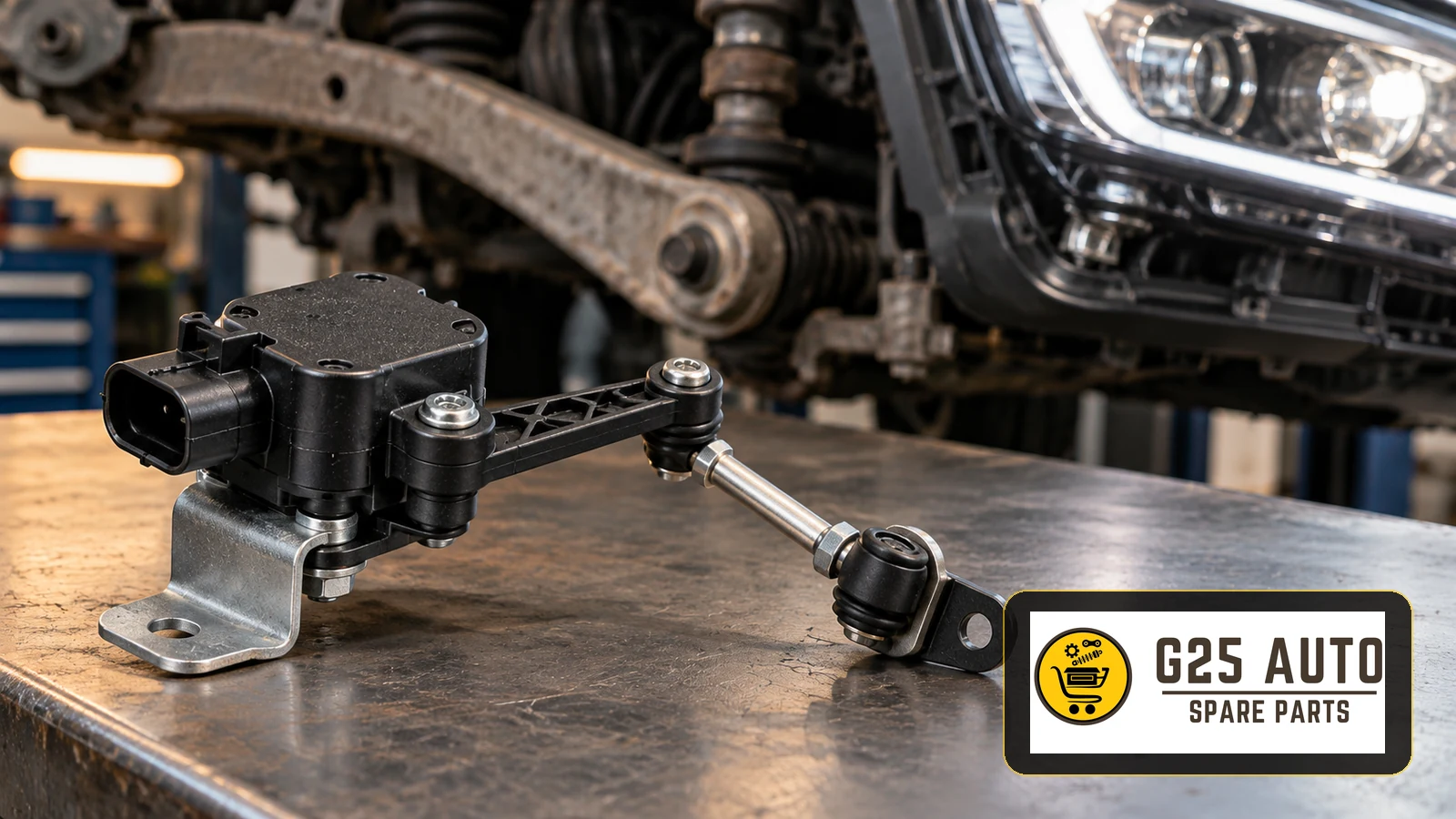
The headlamp level sensor helps the vehicle adjust beam height automatically, supporting visibility and reducing glare. Faults may cause a dashboard warning, beams pointing too low or too high, or loss of height adjustment. This guide explains sensor operation, fault symptoms, diagnosis and replacement.
What Is a Headlamp Level Sensor and How Does It Work?
Headlamp level sensors are components of automatic beam control systems. Depending on the vehicle, they are mounted at the front or rear suspension to provide information for adjusting beam height as vehicle attitude changes.
Sensors measure suspension position and transmit information to the headlamp control unit. The system uses this information to adjust the beams as loading changes; its response depends on the vehicle’s design.
Headlamp Level Sensor Functions
- Support beam adjustment according to vehicle loading
- Help maintain beam direction as vehicle attitude changes
- Reduce glare for other drivers
- Support road visibility
- Contribute to safer driving
Headlamp Level Sensor Fault Symptoms
Recognising symptoms helps workshops investigate problems early. These signs require diagnosis rather than automatically confirming sensor failure.
Common Fault Symptoms
- A dashboard headlamp control warning
- Beams positioned unusually high or low
- Inoperative headlamp height adjustment
- Oncoming drivers repeatedly flashing their lights
- Inadequate road illumination
- Beams pointing excessively upwards when loaded
- Abnormal xenon or LED headlamp operation on some vehicles
- Sensor-related diagnostic fault codes
Specific Situations and Symptoms
Mechanical damage: A broken sensor arm or disconnected suspension linkage may leave the beams in a fixed position.
Electrical fault: Wiring or internal electronic faults may trigger a warning and abnormal beam positioning.
Lost calibration: Incorrect calibration can cause inaccurate beam adjustment even when the sensor appears intact.
Diagnosing Headlamp Level Sensor Faults
Symptoms alone are insufficient. Professional diagnosis should include the following checks.
Professional Diagnostic Methods
Diagnostic scan: Scan the relevant control units with suitable equipment. Codes help identify affected circuits and guide further testing.
Visual inspection: Examine sensors, linkages, wiring and connectors for damage, corrosion and loose connections.
Voltage and resistance checks: Follow the manufacturer’s specified electrical tests and compare results with the applicable specifications.
Live data: Monitor sensor readings while suspension position changes under controlled workshop conditions.
Calibration check: Use the vehicle-specific test procedure to assess calibration.
When Should a Headlamp Level Sensor Be Replaced?
Not every symptom requires replacement. Investigate the sensor or associated components when:
- The housing is broken or cracked
- Internal electronic failure is confirmed
- Linkages are broken or damaged
- The internal mechanism is damaged
- Water ingress has caused internal corrosion
- The problem persists after correct calibration and further diagnosis
Original and Aftermarket Headlamp Level Sensors Compared
Original and aftermarket options require assessment against the same vehicle-specific requirements.
| Factor | Original sensor | Aftermarket sensor |
|---|---|---|
| Compatibility | Verify the correct application | Verify the documented cross-reference and application |
| Cost | Assess the supplier quotation | Compare quotations for the required specification |
| Availability | Confirm with the supplier | Confirm with the supplier |
| Warranty | Check the stated terms | Check the brand and supplier terms |
| Quality | Review product documentation | Review manufacturer documentation |
Selection Considerations
Consider budget, vehicle use and system requirements. Vehicle category alone does not establish suitability. For European and Balkan B2B orders, use reliable suppliers and verify application details and documentation before ordering.
Headlamp Level Sensor Replacement Process
Replacement requires technical knowledge and the correct vehicle-specific procedure.
Preparation Before Replacement
- Position the vehicle on level ground
- Switch off the ignition and follow the manufacturer’s battery isolation procedure
- Prepare suitable tools and equipment
- Confirm the replacement sensor’s application
After Installation
Perform calibration or basic settings as specified by the manufacturer, using appropriate diagnostic equipment and software. Clear relevant codes after repair, test the system and check beam positioning under the prescribed load conditions.
OEM Part Reference and Compatibility Verification
An incorrect sensor can cause installation difficulties or system faults.
Identifying the Correct Sensor
OEM/part reference: Record the existing sensor’s reference and check the proposed replacement against the application catalogue.
VIN verification: Use the VIN with catalogue data. Sensors may differ between production years and equipment versions.
Engine code and production date: Include these details where the catalogue requires them, particularly around model changes.
Equipment specification: Identify the fitted lighting system, including xenon or LED equipment where applicable.
Headlamp Level Sensor Maintenance Checklist
Regular inspection can help identify deterioration:
- Check that sensor linkages move freely
- Inspect wiring and connectors for corrosion
- Check mounting points are secure
- Inspect sensors during suspension servicing
- Check relevant underbody protection for damage
- Check for ice accumulation around the sensor in winter
- Avoid directing high-pressure washing jets at sensors
- Check calibration as required by the service procedure or symptoms
Frequently Asked Questions
Can the vehicle be driven with a faulty sensor?
Incorrect beam positioning can reduce visibility and dazzle others. Assess headlamp operation and arrange prompt professional diagnosis before further driving.
Should both sensors be replaced if only one fails?
Replace confirmed faulty components. Inspect the other sensor for wear; consider any additional replacement based on its condition.
Can a sensor fault affect a roadworthiness inspection?
Incorrect beam aim may affect inspection results, depending on local requirements. This is a lighting issue rather than an exhaust measurement.
Is calibration required after replacement?
Follow the manufacturer’s calibration or basic-setting requirements, using suitable workshop equipment.
Can the sensor be cleaned?
The exterior can be cleaned appropriately, but cleaning does not repair internal mechanical or electronic failure.
Are front and rear sensors different?
They may differ. Specify the mounting position and verify the application when ordering.
Conclusion and Recommendations
Investigate warning lights and abnormal beam behaviour promptly. Select replacement parts using the relevant vehicle details, reference and catalogue checks.
Compare original and aftermarket options through documented suitability and supplier terms. Complete the required calibration and system tests after installation. Regular checks, accurate diagnosis and appropriate repairs help maintain correct headlamp operation.