
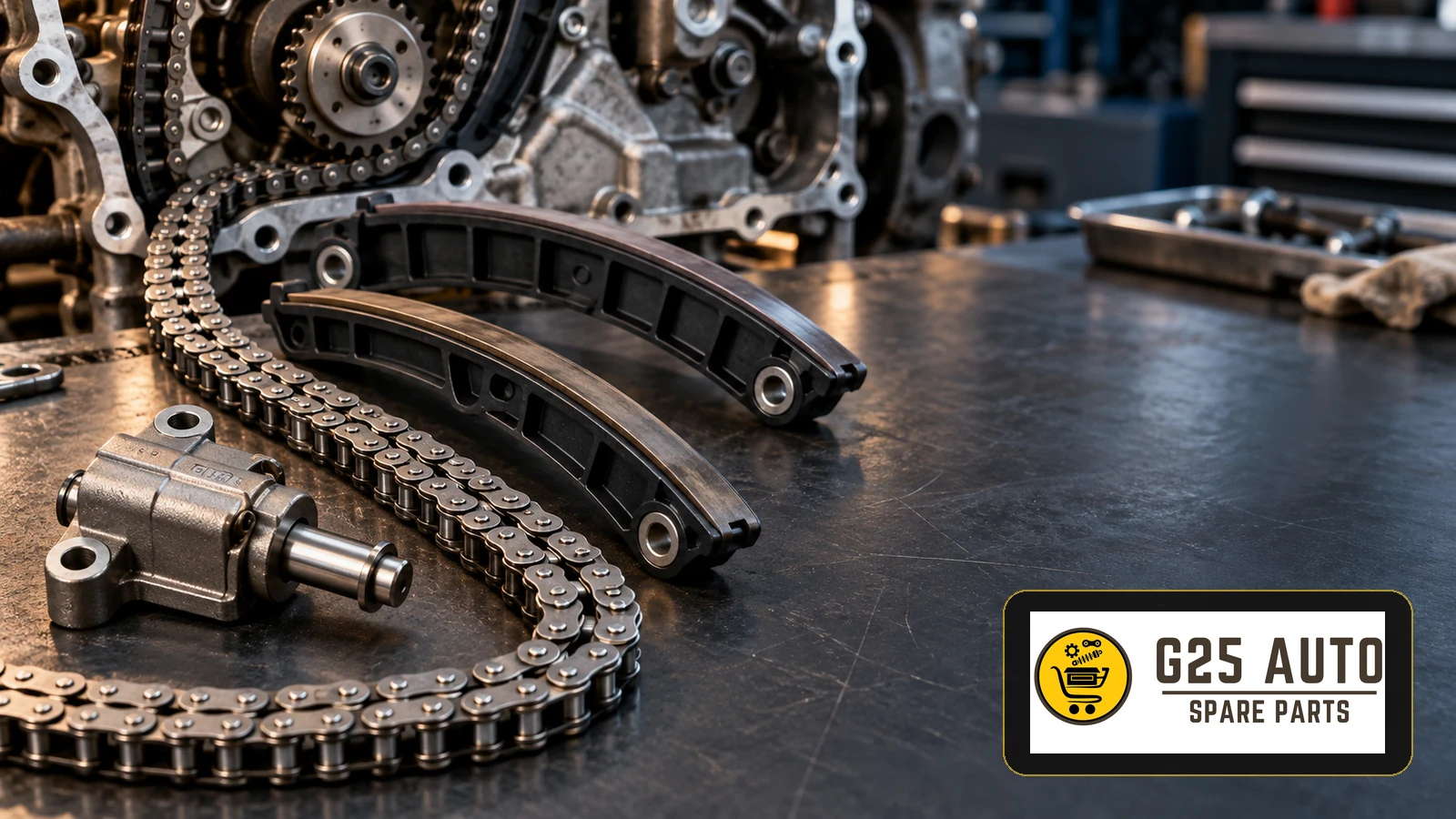
Timing chain tensioners and guides are critical engine timing components. They maintain tension and guide the chain connecting the camshaft and crankshaft. Faults can affect engine performance and cause serious damage.
What Are Timing Chain Tensioners and Guides?
The timing chain synchronises the camshaft and crankshaft. Tensioners and guides support this operation:
Tensioner: Usually spring-operated or hydraulically assisted, it maintains chain tension and accommodates changes during operation within its design limits.
Guides: Often incorporating plastic or composite running surfaces, these parts direct the chain along its intended path and limit unwanted movement.
Fault Symptoms
Recognising symptoms early helps prevent further damage. These signs also have other possible causes and require diagnosis:
Noise and Vibration Symptoms
- Rattling or clicking near the timing cover, particularly during cold starts
- Mechanical noise increasing under acceleration
- High-pitched sounds changing with engine speed
- Unusual vibration through the steering wheel or body
- A different engine sound at idle
Performance Symptoms
- Noticeable power loss
- Increased fuel consumption
- Delayed or uneven throttle response
- An illuminated engine warning light
- Changes in exhaust smoke, which are not specific to timing components
Diagnostic Methods
Symptoms require professional investigation using procedures appropriate to the engine.
Visual Inspection
Once the necessary covers are removed, inspect guides for cracks, breakage and wear. Check the tensioner mechanism according to the service procedure.
Chain Tension Test
Use the specified tools and measurement method to assess chain slack or wear against manufacturer limits.
Electronic Diagnosis
Analyse engine control unit fault codes and camshaft sensor data for possible timing deviations. These findings require further checks.
Mechanical Timing Check
Verify mechanical timing using the engine-specific procedure and equipment. A deviation requires investigation; it does not identify a tensioner or guide fault by itself.
Original and Aftermarket Parts Compared
| Factor | Original Part | Aftermarket Part |
|---|---|---|
| Warranty | Check the applicable supplier terms | Check the part manufacturer’s terms |
| Quality standards | Verify the specified application | Review documented product specifications |
| Price | Request a current quotation | Compare quotations for equivalent scope |
| Availability | Confirm with the supply channel | Confirm with the distributor |
| Fitment documentation | Verify the exact part reference | Check the application listing and restrictions |
| Materials | Review application requirements | Check the individual product specification |
Checklist for Choosing the Correct Part
Before selecting a tensioner or guide:
- Prepare vehicle details: Gather the VIN, engine code and relevant vehicle documents.
- Identify the part reference: Record markings on the existing component.
- Verify the engine code: The same vehicle model may use different engines.
- Check the production date: Revisions can occur within a model year.
- Provide the VIN: Use it alongside catalogue and engine information.
- Check kit contents: Confirm whether tensioners, guides, bolts and seals are included.
- Obtain installation instructions: Establish the required torque settings and sequence.
- Read warranty terms: Clarify coverage and installation conditions.
Why Fitment Verification Matters
Incorrect timing system components can have serious consequences.
Verification by VIN
The VIN supports vehicle identification. Similar vehicles may have different engine or market configurations, so confirm the relevant catalogue restrictions.
Verification by Engine Code
Check the engine identification and service records. Engines of similar displacement may use different chain systems; missing engine information increases ordering errors.
Verification by Production Date
Production revisions can change part references within a model year. Establish the actual build date, which can differ from the first registration date.
Verification by OEM Part Reference
Existing part markings help identify replacement options. Cross-references support selection but must be checked against the full application details and any revisions.
Choosing Aftermarket Parts: An Informed Decision
Assess alternatives using documented specifications and the vehicle’s requirements.
Advantages of Aftermarket Parts
Aftermarket options allow comparison between suppliers, designs and quotations. Manufacturing origin, durability and availability depend on the particular product and require confirmation.
Advantages of Original Parts
Original parts offer the vehicle manufacturer’s specified replacement route. Confirm the exact reference and applicable warranty conditions; branding alone does not establish fitment.
How to Make the Choice
Consider vehicle condition, budget and use. European and Balkan B2B buyers should compare documented specifications, supplier terms and application evidence, whichever supply route they choose.
Installation and Maintenance Advice
Correct installation matters as much as part selection.
Prioritise Professional Installation
Incorrect timing assembly can cause valve-to-piston contact on affected engines. Use an experienced workshop with the required procedures and equipment.
Points to Check During Installation
- Align timing references as specified.
- Apply the manufacturer’s torque settings and tightening sequence.
- Renew gaskets and seals where required by the procedure.
- Follow the applicable oil service requirements.
- Verify timing after assembly using the prescribed method.
Periodic Inspection
Follow the manufacturer’s maintenance guidance. Include timing system assessment where specified, particularly when symptoms or service findings justify it.
Frequently Asked Questions
When should tensioners and guides be replaced?
Follow engine-specific guidance and component condition. Investigate symptoms promptly regardless of mileage, and assess associated components during chain replacement.
Should only the tensioner or the complete kit be replaced?
Assess the chain, tensioner and guides together. Replacement scope depends on wear, service instructions and kit contents; labour and cost vary.
Can tensioner or guide failure damage the engine?
Yes. Lost tension or a broken guide can allow the chain to jump or fail, disrupting timing. Valve-to-piston contact is possible on interference engines.
Are aftermarket tensioners and guides as durable as original parts?
Durability depends on the product, application and installation. Review documented specifications and supplier information instead of assuming equivalence or longer service life.
Will performance change after installation?
Repairing a confirmed timing fault may restore normal running and reduce associated noise or vibration. Performance and fuel consumption improvements are not guaranteed.
Conclusion
Tensioners and guides support reliable engine timing. Recognise symptoms, follow maintenance guidance and replace worn components as required. Check the VIN, engine code, build date and part references to reduce selection errors.
For either original or aftermarket parts, prioritise documented quality, reliable sourcing and professional installation.
Assess the complete repair: appropriate parts, correct installation and maintenance all matter.