
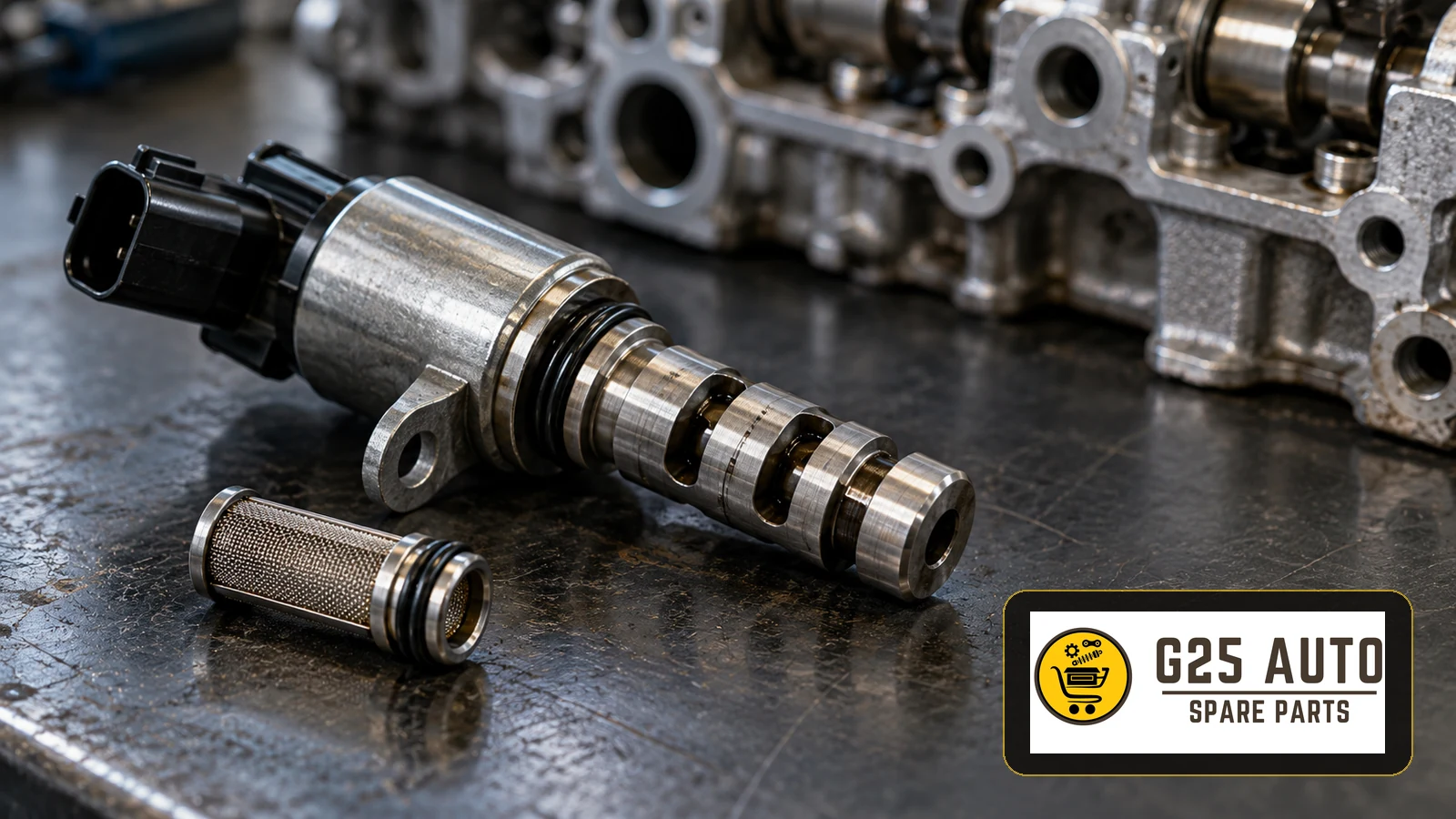
Camshaft adjustment solenoids and oil strainers support variable valve timing. The solenoid controls oil flow in response to electrical signals; the strainer helps protect its passages from contamination. Together, they support engine performance, fuel efficiency and emissions control.
What Is a Camshaft Adjustment Solenoid and How Does It Work?
The VVT solenoid is an actuator controlled by the engine control unit (ECU). Using engine speed, load and temperature information, the ECU adjusts valve timing through the system.
The solenoid regulates oil flow to the camshaft adjustment mechanism, allowing valve opening and closing times to change with operating conditions. This supports torque, power and fuel efficiency.
Construction and Components
A typical solenoid includes:
- Electromagnetic coil: converts electrical signals into movement.
- Spool and piston: direct oil flow.
- Passages: guide oil through the valve.
- Housing and seal: contain oil.
- Electrical connector: connects to the control circuit.
The Oil Strainer: Protecting the System
The solenoid needs clean engine oil. Its strainer captures debris, including metal particles and deposits, helping prevent contamination of sensitive passages.
Strainers use fine mesh or porous material. Filtration characteristics depend on the application.
Strainer Locations
Depending on the engine, the strainer may be:
- Integrated into the solenoid inlet.
- A separate component in an oil passage.
- At the solenoid mounting point.
- Within the camshaft cover assembly.
Fault Symptoms: Recognising Problems
Solenoid or strainer problems can cause several symptoms. These overlap with other engine faults and require professional diagnosis.
Observable Symptoms
- Illuminated engine warning light.
- Rough idle or vibration.
- Reduced power when moving off or at low speed.
- Increased fuel consumption.
- Ticking or rattling near the engine cover.
- Delayed throttle response.
- Increased exhaust emissions.
- Power loss accompanied by engine vibration.
- Difficult cold starting.
Diagnostic Codes
A scan may reveal faults relating to:
- Camshaft adjustment control circuits.
- Camshaft timing performance.
- Misfires.
- Camshaft position sensors.
Reminder: Interpret codes using engine-specific information. They do not establish the cause alone; restricted oil flow may also affect solenoid operation.
Professional Diagnosis
A qualified workshop can investigate systematically:
Diagnostic Steps
- OBD scan: Read codes and freeze-frame data.
- Visual inspection: Check connectors, wiring and oil leaks.
- Electrical testing: Compare coil resistance with manufacturer specifications.
- Oil pressure: Check against the engine specification.
- Oscilloscope testing: Examine control signals where appropriate.
- Strainer inspection: Check for blockage using the service procedure.
- Mechanical inspection: Assess valve movement using the specified method.
Maintenance and Inspection Checklist
Regular maintenance helps protect the solenoid and strainer.
Routine Maintenance Checklist
- Change engine oil at the manufacturer’s intervals.
- Use the specified oil grade and approvals.
- Check oil level regularly; avoid running with insufficient oil.
- Investigate engine warning lights promptly.
- Inspect the solenoid and strainer as specified or when symptoms arise.
- Replace the engine oil filter according to the maintenance schedule.
- Check electrical connectors for moisture and contamination.
- Investigate unusual engine-cover noises.
- Include emissions checks in applicable inspections.
Choosing Original or Aftermarket Parts
Both original and aftermarket replacement options require application checks.
Original Parts
Original parts are supplied through the vehicle manufacturer’s parts programme. Confirm the correct reference, current revision, commercial terms and applicable warranty conditions.
Aftermarket Parts
Independent manufacturers offer alternatives. Assess application data, specifications and supplier documentation; performance, availability and pricing vary.
Comparison Table
| Factor | Original part | Aftermarket part |
|---|---|---|
| Compatibility | Confirm reference and application | Verify cross-reference and application |
| Cost | Obtain a quotation | Compare quotations |
| Availability | Confirm with supplier | Confirm with supplier |
| Quality | Check specification | Review documented specification |
| Warranty | Review applicable terms | Review supplier terms |
| Choice | Application-dependent range | Application-dependent brands |
Essential Part Identification Information
For European and Balkan B2B enquiries, provide:
- Part reference: Check the reference and any supersession.
- VIN: Support identification with application data.
- Engine code: Models can have different engines.
- Production date: Revisions may affect selection.
- Engine capacity and output: Distinguish engine variants.
- Transmission type: Include where relevant to the application.
Important: Model and year alone may be insufficient. Incorrect selection can cause installation problems, recurring faults or damage.
Installation and Replacement
Working on the engine requires application-specific knowledge and care.
General Replacement Steps
- Allow the engine to cool.
- Follow the vehicle’s battery isolation procedure.
- Disconnect the solenoid connector.
- Remove fasteners and the solenoid as specified.
- Inspect the strainer; replace where required.
- Clean mounting surfaces using the approved method.
- Install the replacement with the specified seal.
- Tighten to the manufacturer’s specification.
- Reconnect electrical connections.
- Record and clear codes as appropriate, then test operation.
Recommendation: Use a qualified workshop with suitable equipment. Incorrect installation can damage the engine.
Frequently Asked Questions
How Long Does a Camshaft Adjustment Solenoid Last?
Service life depends on oil quality, operating conditions and maintenance. A universal mileage cannot be assumed.
How Often Should the Strainer Be Replaced?
Follow engine-specific guidance. Inspect during related repairs; contamination or neglected maintenance may warrant additional attention.
Can a Solenoid Fault Affect Driving Safety?
Power loss or irregular running can affect manoeuvres such as overtaking. Have symptoms assessed promptly.
Is Cleaning the Strainer Enough?
Cleaning is appropriate only where the service procedure permits it. A damaged or persistently restricted strainer may need replacement.
Can Incorrect Oil Contribute to Failure?
Unsuitable oil can affect hydraulic operation and deposit formation. Use the manufacturer’s specified oil.
Can Intake and Exhaust Solenoids Both Be Affected?
Where separate solenoids are fitted, a shared problem such as contaminated oil can affect both. Inspect related components during diagnosis.
Conclusion and Recommendations
Camshaft adjustment solenoids and strainers support efficient engine management. Correct oil maintenance helps protect their operation.
Use specified oil and service intervals. Investigate warning lights or unusual running promptly.
When replacing parts, assess quality and verify application details with a reliable supplier. Diagnose the underlying cause alongside the failed component, and use professional installation and maintenance practices.