
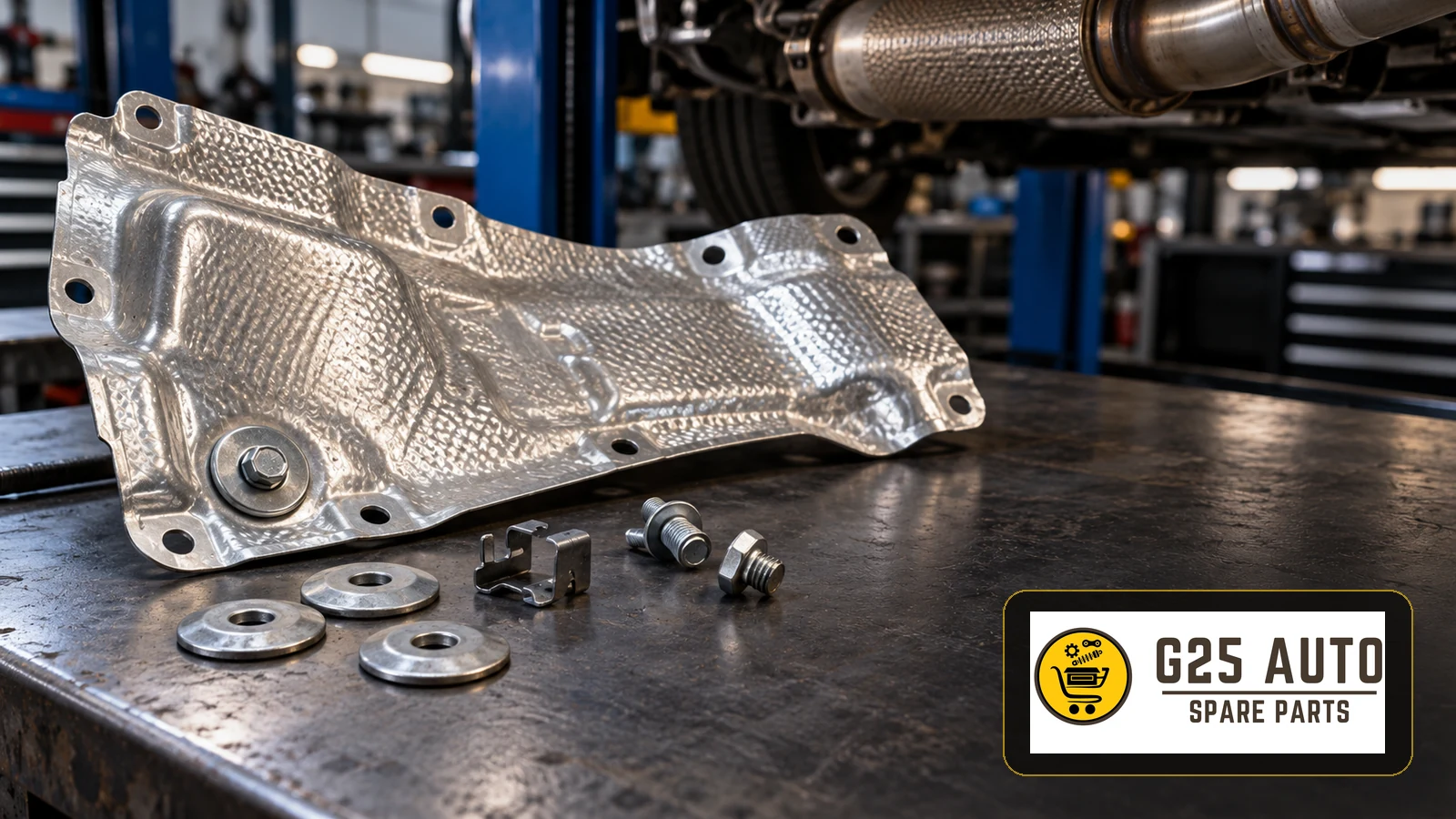
Exhaust heat shields and mounting washers help protect surrounding components from high temperatures. This guide explains how these parts work, the symptoms of mounting problems, and the checks involved in selecting, installing and maintaining replacements.
What is an exhaust heat shield, and why does it matter?
Heat shields are protective panels around exhaust manifolds and pipes, often made from stainless steel or aluminium. They limit heat exposure to plastics, wiring, fuel lines and other nearby components.
Exhaust temperatures vary with operating conditions. Without suitable protection, excessive heat can damage plastics and cable insulation. Correctly positioned shielding helps manage heat exposure around the exhaust system and neighbouring engine-bay components.
The role of mounting washers and fasteners
Secure mounting keeps the shield positioned correctly. Fasteners must suit the application’s heat exposure. Depending on the design, mounting hardware includes:
- Heat-resistant metal washers
- Spring washers where specified
- Application-specific bolts and nuts
- Insulating spacers or washers
- Clips and mounting brackets
Why material quality matters
Washer material and corrosion resistance must suit the installation. Stainless steel or other specified alloys may be used, depending on the design. Unsuitable hardware can deform or corrode over time, weakening the mounting and allowing the shield to loosen.
Fault symptoms: when is attention needed?
Heat-shield and mounting faults can produce several warning signs. Recognising them early and arranging inspection can help prevent further damage. Individual symptoms do not establish the cause.
Common symptoms
- Rattling: metallic noises can indicate loose or cracked shielding.
- Burning smell: nearby plastics may be overheating.
- Excessive bonnet heat: investigate unusual engine-bay temperatures.
- Electrical problems: heat-damaged insulation is one possible cause.
- Visible damage: melted, discoloured or distorted plastics.
- Increased vibration: a loose shield may resonate.
Checks to support diagnosis
Symptoms require professional assessment. A technician can check:
- Shield condition and mounting points
- Fastener security and integrity
- Heat damage to surrounding components
- Temperature distribution using thermal imaging, where appropriate
- Corrosion and material fatigue
Choosing original or aftermarket parts
Replacing a heat shield or its fasteners may involve choosing between original and aftermarket products. Each option needs assessment against the vehicle application. Compare the specific products and their documentation before ordering.
Original equipment parts
Original equipment parts are supplied for vehicle-manufacturer applications. Check the precise listing rather than assuming that the category guarantees an easy installation or a particular service life. Assess:
- Application and mounting requirements
- Vehicle-manufacturer specifications
- Documented durability information
- Available technical documentation
Commercial considerations include:
- Quoted cost
- Confirmed supply arrangements
- Available suppliers
Aftermarket parts
Aftermarket parts are alternatives from independent manufacturers. Their quality, specifications and application coverage vary. Confirm claimed standards against the documentation for the actual product. Compare:
- Quoted cost
- Manufacturer and supplier options
- Confirmed availability
- Documented performance characteristics
Check:
- Manufacturer quality information
- Material specifications and relevant supporting documents
- Application suitability
Verifying the selection
Whichever option you choose, verify the intended application before purchase. Use the following information together; no single identifier guarantees fitment:
- Original part reference: check the applicable catalogue listing.
- VIN: supports vehicle identification.
- Engine code: distinguishes engine variants.
- Production date: helps identify specification changes.
Incomplete identification increases ordering errors for European and Balkan workshops and parts businesses.
Comparing materials and their properties
Material names alone do not establish performance. Compare product specifications:
| Property | Stainless steel shield | Aluminium shield | Composite shield |
|---|---|---|---|
| Heat resistance | Grade-dependent | Alloy-dependent | Composition-dependent |
| Corrosion resistance | Check grade | Check finish | Check specification |
| Weight | Check panel mass | Check panel mass | Check panel mass |
| Durability | Application-dependent | Application-dependent | Application-dependent |
| Vibration behaviour | Design-dependent | Design-dependent | Design-dependent |
| Installation | Check mounting design | Check mounting design | Check mounting design |
Installation and maintenance checklist
During installation or maintenance, use this checklist alongside the applicable service instructions. Washer order, tightening sequence, clearances and any locking method depend on the specific mounting design.
Before installation
- Recheck part reference and application.
- Check that specified mounting hardware is complete.
- Allow the engine and exhaust to cool fully.
- Clean mounting areas as instructed.
- Prepare suitable tools.
During installation
- Position the shield before final tightening.
- Align all mounting points.
- Fit washers in the specified order.
- Follow the specified tightening sequence.
- Use the manufacturer’s torque specification.
- Check the specified clearance from exhaust pipes.
- Use locking devices or compounds only as specified.
After installation
- Visually inspect every mounting point.
- Check for looseness with the system cool.
- Confirm fastener security.
- Check clearances around wiring and hoses.
- Run the engine and listen for abnormal noises.
- Arrange follow-up checks as specified.
Frequently asked questions
Can a vehicle operate without its exhaust heat shield?
It may run, but missing shielding can expose plastics, wiring and hoses to damaging heat and create safety risks. Have the intended protection restored professionally.
What do heat-shield noises mean?
Rattles can indicate loose fasteners or a cracked panel. Arrange inspection before further deterioration.
Should corroded washers be replaced?
Assess their condition and replace weakened or damaged hardware according to service instructions.
Can I install a heat shield myself?
Suitable experience, tools and safe vehicle access are essential. Working beneath the exhaust involves risks and requires appropriate lifting equipment. Professional installation is appropriate when these are unavailable.
How often should shields be checked?
Follow the vehicle’s service guidance. Road salt, harsh use or new symptoms can justify additional inspection.
Can aftermarket shields outperform original parts?
Assess documented performance for the intended application. Material or design differences alone do not establish superiority or suitability.
Recommendations for selecting the right parts
Quality indicators
- Materials: check composition and specified treatment.
- Surface finish: assess corrosion protection.
- Certificates: verify scope and relevance where provided.
- Manufacturer: assess documented quality.
- Warranty: review the actual terms.
Application verification steps
- Record the VIN from vehicle documentation or identification.
- Identify the engine code.
- Confirm production year and month.
- Check references on existing components.
- Share this information with the supplier.
- Recheck the supplied part reference before acceptance.
Maintenance and durability tips
- Visual checks: look for damage during routine inspection.
- Cleaning: remove dirt and salt using an approved method.
- Corrosion protection: follow application-specific instructions.
- Security: inspect after rough-road use or new rattles.
- Vibration: investigate contributing engine-mount faults.
- Professional assessment: include shielding in scheduled servicing.
Conclusion
Heat shields and their mounting hardware help protect surrounding components. Investigate unusual noises, inspect regularly and replace damaged parts as required.
Whether sourcing original or aftermarket parts, check quality and application details using part references, VIN, engine code and production date. These checks help reduce the risk of ordering an unsuitable component. Seek professional support for exhaust-system maintenance.