
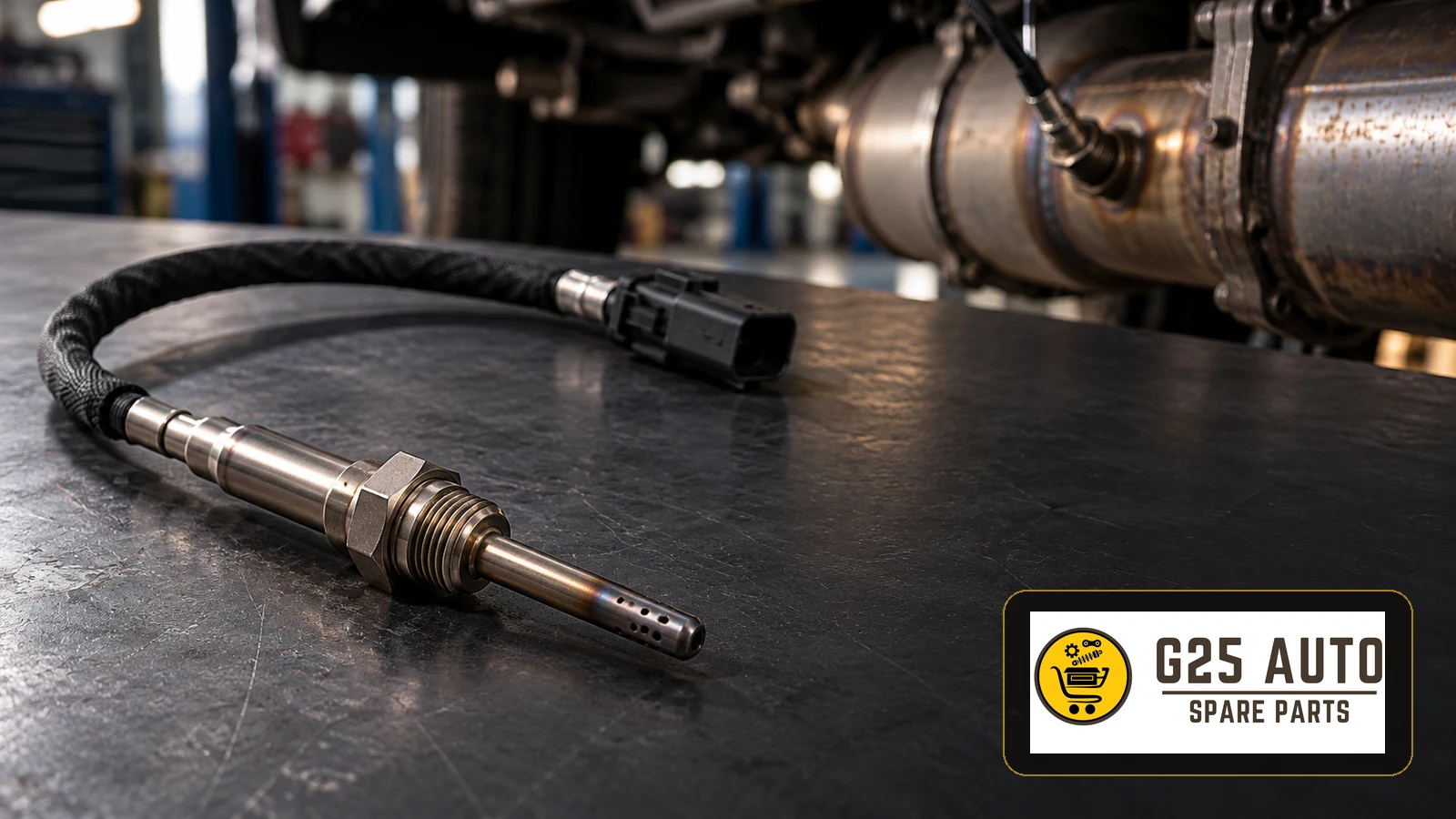
An exhaust gas temperature (EGT) sensor measures exhaust temperature and sends data to the engine control unit (ECU). In modern diesel engines, these readings support emissions control, diesel particulate filter (DPF) regeneration and protective engine management. A faulty signal can contribute to reduced performance, increased fuel consumption and emissions problems.
What is an EGT sensor and how does it work?
Several EGT sensors may be fitted around the turbocharger and exhaust aftertreatment system. Their number and positions depend on the application.
The sensing element responds electrically to temperature changes. The ECU interprets its signal and uses it in engine and regeneration control. Test methods depend on the sensor design.
Key functions of an EGT sensor
- DPF regeneration: Monitoring exhaust temperatures during filter regeneration.
- Emissions control: Supporting temperature-dependent emissions management.
- Engine protection: Providing temperature information for protective strategies.
- Fuel management: Supplying data used in operating adjustments.
- Turbocharger protection: Supporting exhaust-temperature monitoring where applicable.
EGT sensor fault symptoms
The following symptoms require diagnosis; none proves that the EGT sensor itself is faulty.
Dashboard warnings
- Check-engine light.
- Persistent DPF warning.
- Emissions-system warning.
- Reduced-power message.
Reduced performance
- Noticeably reduced engine power.
- Restricted operation or limp mode.
- Delayed acceleration response.
- Power loss at higher engine speeds.
Fuel consumption and running problems
- Higher fuel consumption than usual.
- Irregular engine operation.
- Unstable idle.
- Black exhaust smoke.
DPF-related problems
- Incomplete regeneration.
- Unusually frequent regeneration requests.
- Unexpectedly high indicated filter loading.
- Abnormal operation during regeneration.
Fault finding and diagnosis
Accurate diagnosis requires suitable equipment and application-specific service information.
Professional diagnostic checks
- OBD scan: Read fault codes and their vehicle-specific definitions.
- Live data: Review the reported temperature and its behaviour.
- Electrical inspection: Check wiring and connectors.
- Resistance testing: Use a multimeter only where the specified procedure permits it.
- Comparison: Compare sensors under the relevant operating conditions, allowing for their different positions.
A fault code alone does not identify the failed component. Wiring damage or connector corrosion can produce similar indications, so inspect the circuit before ordering a sensor.
Genuine and aftermarket EGT sensors compared
| Factor | Genuine part | Aftermarket part |
|---|---|---|
| Fitment | Confirm the application and sensor position. | Confirm the application and cross-reference. |
| Quality specification | Check the specified part requirements. | Check documented technical specifications. |
| Availability | Confirm with the supplier. | Confirm with the supplier. |
| Warranty | Check the applicable terms. | Check the applicable terms. |
| Cost | Request a current quotation. | Compare quotations for verified applications. |
| Quality control | Review available product documentation. | Review manufacturer and product documentation. |
Both categories require careful identification. A brand name or cross-reference alone does not establish identical specifications or performance.
Checklist for choosing the correct part
- Have the vehicle identification number (VIN) ready.
- Identify the engine code.
- Record the production year and month.
- Check the reference on the existing sensor.
- Identify the number of EGT sensors and the affected position.
- Ask the supplier to verify the application using these details.
- Check the connector and cable length against the specified replacement.
- Clarify warranty terms and duration.
- Review relevant product documentation and any applicable certification claims.
- Agree return and exchange conditions before ordering.
Why VIN and part-reference verification matters
Production changes and different suppliers can result in different sensors within the same vehicle model. VIN-based catalogue information can help identify:
- Production date.
- Engine type and code.
- Equipment specification.
- Production market.
- Factory configuration.
The existing sensor’s OEM or part reference is another useful identification point, but any replacement or superseding reference needs catalogue verification. Engine code and production date help distinguish changes introduced during a model’s production.
What to check when buying aftermarket parts
Manufacturer and brand reliability
Choose a supplier with traceable product information. Assess the particular sensor rather than assuming that a recognised brand guarantees equivalence.
Technical specifications
Verify the operating temperature range, electrical characteristics and relevant resistance specifications in the technical documentation for the application.
Warranty and support
Confirm warranty coverage and the technical support available for the supplied product.
Important installation and replacement points
- Heat exposure can make threaded connections difficult to release.
- Allow the exhaust to cool before removal.
- Use thread treatments only when the sensor manufacturer’s instructions specify them.
- Keep electrical connections clean and dry.
- After replacement, follow the prescribed fault-code clearing and functional or road-test procedure.
Professional installation helps ensure correct handling and subsequent checks.
Frequently asked questions
Does an EGT fault always prevent driving?
The engine may continue running with restricted power. Follow the vehicle’s warning instructions and obtain a diagnosis promptly; unresolved regeneration problems can affect the DPF.
At what mileage or age should the sensor be replaced?
Do not assume a universal replacement interval. Follow the maintenance information and replace a sensor when diagnosis establishes a fault.
Does a regeneration problem always mean an EGT sensor fault?
No. Filter blockage, differential-pressure or airflow sensor faults and injection problems can also be involved. Further investigation is necessary.
Can an EGT sensor be cleaned?
The sensing element is delicate. Follow the manufacturer’s handling guidance; cleaning should not be assumed to repair an internal sensor fault.
Must all EGT sensors be replaced if one fails?
One confirmed failure does not automatically justify replacing every sensor. Assess the other sensors separately.
What if the fault code returns after clearing?
Recheck the diagnosis, replacement application, installation and wiring. Consider control-unit software only where the relevant service information calls for it.
Conclusion and recommendations
EGT readings support diesel engine and aftertreatment management. Investigate warnings promptly and verify the VIN, engine code, production date, sensor position and existing reference before procurement.
For European and Balkan workshops and trade buyers, documented application suitability should guide genuine or aftermarket selection. Use qualified technicians for replacement and any prescribed post-installation checks or calibration.