
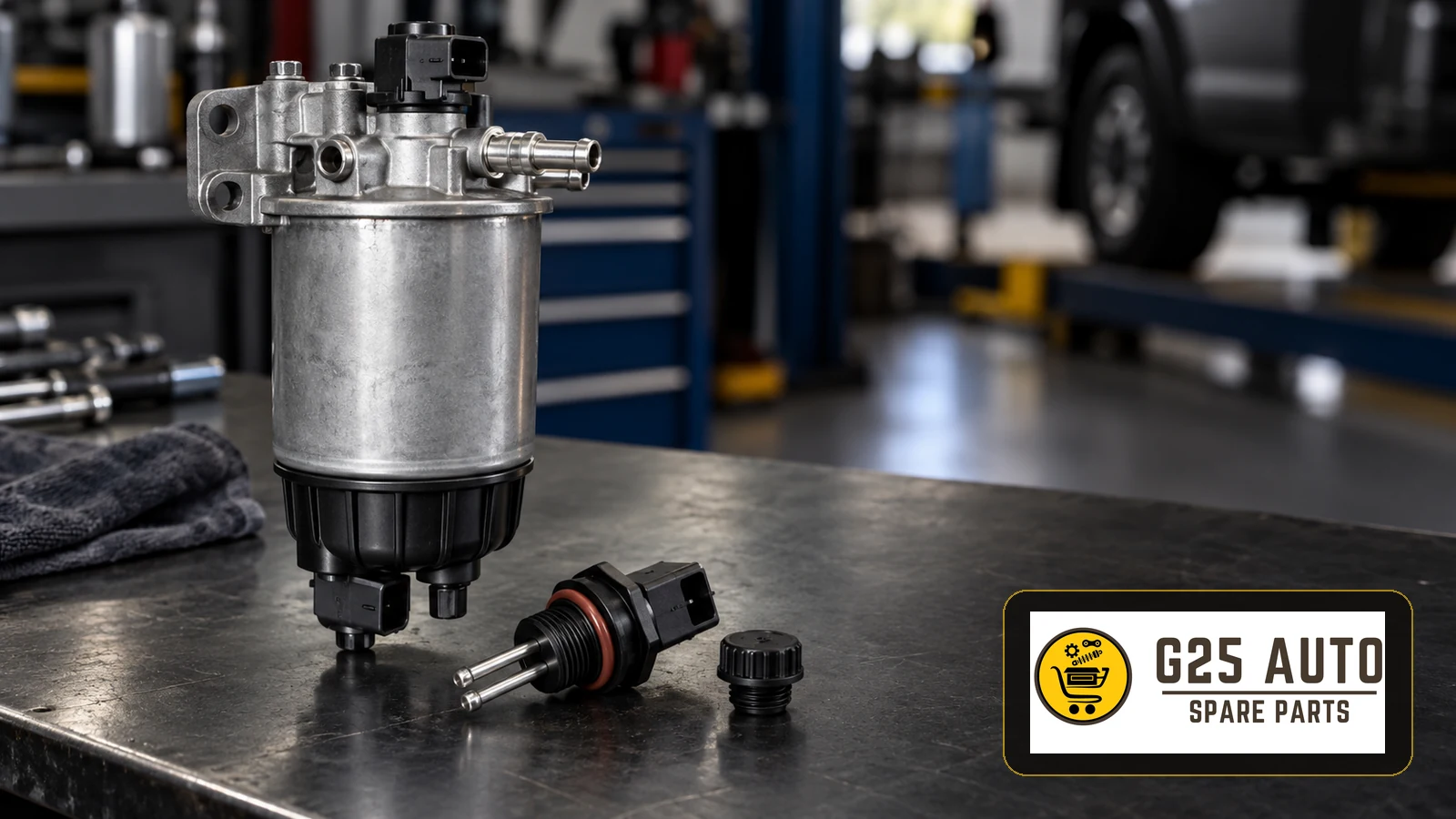
A diesel water-in-fuel sensor warns of water collected in the filter or separator, while the drain provides a controlled way to remove that collected liquid. A warning needs prompt attention under the vehicle manufacturer’s instructions; it does not, by itself, prove that the sensor needs replacing. For European and Balkan workshops and parts buyers, the right approach is to investigate the contamination or electrical concern, identify the installed filter assembly and order the correct sensor, drain and seals against documented application data.
What the sensor and drain actually do
The sensor monitors the water condition; the filter and separator perform the separation work. Bosch’s diesel filter overview describes the water drain, sensing element and electrical connection as distinct functions. A sensor therefore cannot compensate for an unsuitable or neglected filter. Water contamination can damage the fuel system, so an illuminated warning should become a workshop investigation rather than a routine lamp reset.
Before discussing a replacement, name the component precisely. A request for a fuel filter sensor might refer to a different function on another assembly. Ask for photographs showing the complete housing, the lower connection and the electrical plug, together with readable identification markings. Keep the vehicle identity and the installed filter identity together in the job record.
Investigate the warning before ordering parts
Record the operating and service history
Ask when the warning appeared, whether the vehicle had recently been refuelled and whether the filter was recently serviced. Record any starting complaint, visible leakage and diagnostic findings without turning them into a confirmed cause. A useful report distinguishes what the driver observed, what the technician found and what remains to be tested. That distinction helps a distributor avoid supplying a sensor merely because it appears in a fault description.
Separate contamination from an electrical concern
The Ram diesel separator instructions distinguish a water warning from a possible wiring or sensor problem in the application they cover. They also warn against draining with the engine running and against overtightening the sensor drain. Those instructions demonstrate why warning behaviour and handling requirements must be checked for the actual vehicle; the Ram warning sequence is not a diagnostic rule for European fleets.
Where the warning persists, request the technician’s documented conclusion before authorising a replacement. Do not bridge connector terminals or substitute an assumed resistance value to extinguish the lamp. Use the applicable wiring information and diagnostic procedure. If contamination is confirmed, the repair plan must address that finding rather than treating a new sensor as the complete remedy.
Use the correct draining and recommissioning procedure
Ford’s water-trap maintenance section calls for action when the warning appears, suitable collection of the drained liquid, disposal through an authorised facility and application-specific air purging afterwards. Its drain handling and ignition sequence belong to the handbook application. They should not be copied into a universal workshop recipe.
Before work begins, the technician should have the current procedure for the installed system, including safe isolation, drain operation, seal handling and any required priming. Keep fuel away from ignition sources and contain spills. A quick drain should never become an improvised repair to a damaged housing or thread. Document completion of the prescribed leak and warning checks before handing the vehicle back.
B2B identification and ordering checklist
Send the following information as one enquiry so the supplier can return a clear, traceable proposal:
- Vehicle identity: VIN, engine identification and production details from the workshop record.
- Installed assembly: filter or separator manufacturer, readable housing markings and any recorded replacement history.
- Requested item: sensor, drain plug, seal kit, filter element or complete assembly, with the workshop’s diagnosis attached.
- Connection evidence: photographs of connector keying, locking features, sealing seat and attachment arrangement.
- Reference confirmation: a catalogue application check and any documented supersession or cross-reference.
- Package contents: written confirmation of included seals and fittings, and any components intended for transfer.
- Technical support: access to the relevant installation information and a route for resolving a mismatch before fitting.
- Commercial terms: a written quotation covering the proposed item, availability, delivery terms and warranty conditions.
Compare offers and inspect incoming parts
Compare like-for-like supply units. A quote for a bare sensor should not be assessed as though it includes a drain, seals and filter. An original-equipment label or an aftermarket brand name does not replace application verification. Ask the supplier to resolve ambiguous references in writing rather than accepting a photograph as confirmation of interchangeability.
At receipt, match the delivered label and item to the accepted quotation. Check for transit damage, missing seals and differences from the documented connection arrangement. Keep discrepancies separate from installation work until they are resolved. For workshops serving mixed fleets across borders, retaining the same enquiry, approval and receiving record also makes later reordering more reliable.
Frequently asked questions
Does a water-in-fuel warning mean the sensor has failed?
No. Treat water contamination as a possibility and follow the vehicle’s warning instructions. Confirm the cause through the appropriate checks before ordering a sensor.
Can a similar-looking drain plug be substituted?
Only with documented application confirmation. Appearance alone does not establish that the attachment and sealing arrangement are suitable.
Should every filter change include a new sensor?
Use the applicable service instructions and the supplied kit specification. Do not assume either automatic replacement or automatic reuse.
What should a cross-border parts enquiry include?
Provide vehicle and filter identification, photographs, the diagnosed concern and the required package contents. Obtain written technical and commercial confirmation before approving the order.