
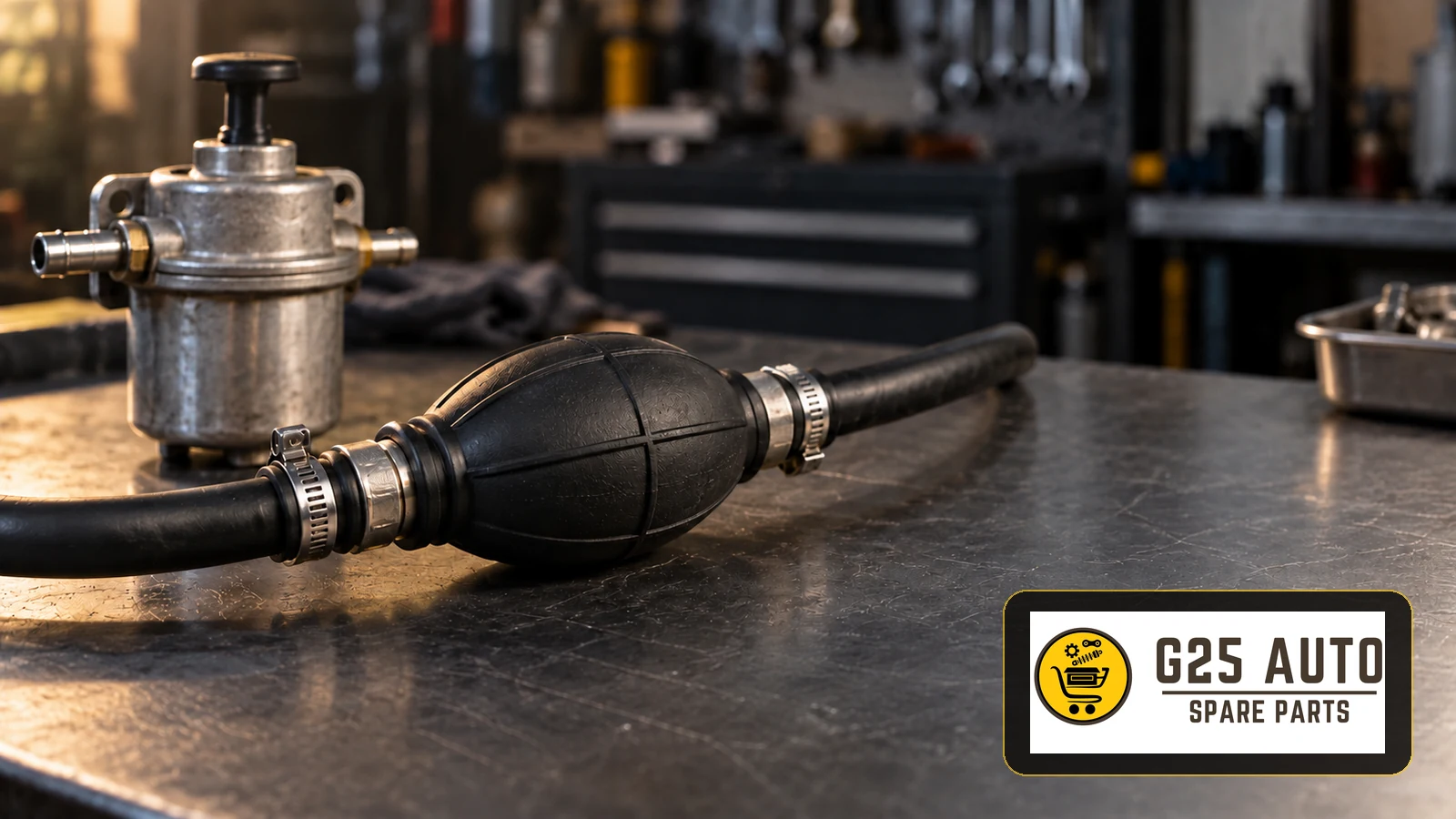
A diesel hand primer helps refill the fuel supply circuit and remove trapped air where the vehicle is designed for manual priming. Difficult starting or repeated loss of prime calls for a check of the complete supply circuit before ordering a replacement bulb, plunger or filter-head assembly. For European and Balkan workshops, the practical approach is to identify the installed system, confirm the fault and match the replacement to documented vehicle and component information.
Identify the priming system before diagnosing it
Start the job record with photographs of the installed primer, filter housing and pipe connections. Establish whether the vehicle has a rubber squeeze bulb, a manual plunger or an electrically operated supply system. Do not select a replacement simply because another vehicle in the fleet has a similar-looking part.
Manual and electric arrangements need different instructions
Renault’s Kangoo Be Bop handbook describes a manual priming bulb for the diesel version covered by that document. This establishes an application-specific arrangement, rather than a procedure for every diesel engine. The workshop must obtain the instructions for the actual vehicle before deciding which controls, vents or connections are involved.
By comparison, the cited Ford diesel handbook section uses an ignition-operated purging process after running out of fuel. Its sequence and starter limits belong to that application. Neither handbook supports fitting a universal primer or transferring a pumping routine between unrelated vehicles.
Treat loss of prime as an investigation
Ask when the problem began: after filter maintenance, after the tank ran empty, after a pipe was disturbed or during an overnight stop. Record whether manual priming changes the starting behaviour. This history helps define the inspection, but it does not prove that the primer itself has failed.
A bulb that feels unusually soft or difficult to compress is an observation to compare with the correct service procedure. Avoid treating hand pressure as a calibrated test or declaring an injection pump defective from this symptom alone. Keep visible damage, reported symptoms and confirmed test results separate in the job notes.
Inspect the surrounding supply circuit
Look for damaged hoses, disturbed joints and evidence of leakage around the primer and filter assembly. Parker’s Racor turbine-filter instructions explain that damaged or dirty seals can admit air, and that a unit losing prime warrants inspection of upstream hose connections. Their troubleshooting also includes fuel level, fittings, the drain and possible restriction. These are useful inspection principles; Racor assembly specifications and repair steps must not be applied to an unrelated vehicle filter.
If the visual inspection does not locate the problem, use the vehicle manufacturer’s diagnostic method and suitable equipment. Record the test point, operating condition, result and applicable limit. A supplier enquiry saying only “hard starting” is insufficient evidence for selecting a component.
Build a replacement enquiry that can be checked
The purchasing file should connect the diagnosed defect with a clearly defined supply item. Request a bulb alone only when the application supports that repair; otherwise establish whether the required item is a hose assembly, filter head or another specified service unit. Ask what seals, connectors and installation instructions are included.
Provide the VIN, engine identification, build information, installed component markings and clear connection photographs. Ask the supplier to document the application match and any supersession. Treat a cross-reference as something to verify against the application, rather than a guarantee of interchangeability.
For a proposed hose or primer, request confirmation of the intended fuel, installation position, connection design and applicable operating limits. Do not substitute dimensions estimated from a photograph. A part that can be physically attached still needs an evidenced application match.
Compare offers on the same basis
Compare equivalent supply units with written inclusions and exclusions. Record the quoted commercial terms, required documentation and agreed return conditions in the purchase order. Across workshop and distribution teams in different countries, retaining the same component reference and annotated photographs makes the enquiry easier to review without relying on translated nicknames.
Workshop and purchasing checklist
- Record vehicle identity, engine details and the installed priming arrangement.
- Document the complaint and any recent fuel-system maintenance.
- Separate inspection observations from verified diagnostic findings.
- Identify the failed component and the permitted replacement assembly.
- Obtain a documented application match and confirm connection details.
- Agree which seals, fittings and instructions accompany the order.
- Inspect the received item and its identification before installation.
- Retain the priming, leak-check and repair-verification record.
Complete the repair with controlled verification
Installation and priming should follow the current instructions for the vehicle and replacement component. Keep exposed fuel connections protected from contamination. Delphi’s common-rail injector replacement guidance emphasises checking for residual pressure and capping exposed components. Although that article concerns injector replacement, it reinforces why the high-pressure system needs controlled handling. Do not improvise an air-bleeding method by loosening common-rail injector pipes.
Have the workshop document the prescribed post-repair checks and whether the original starting complaint has been resolved. If the symptom returns, reopen the diagnosis rather than ordering another identical primer without new evidence. Link the findings to the installed part and purchase record so any subsequent technical enquiry starts from an accurate repair history.
Frequently asked questions
Does a soft primer bulb prove the bulb is faulty?
No. Interpret its behaviour using the application procedure and investigate the surrounding supply circuit before selecting a replacement.
Can the same priming procedure be used on every diesel?
No. Manual and electrically operated arrangements differ. Use the instructions for the exact vehicle and engine.
Will replacing a hose always cure loss of prime?
Only a confirmed hose defect justifies that repair. Recheck the original complaint after installation rather than assuming the whole fault has been resolved.
Is an original-equipment reference enough to place an order?
Use it alongside vehicle identification, component details and a documented application check. Confirm the supplied assembly and its included items before purchase.