
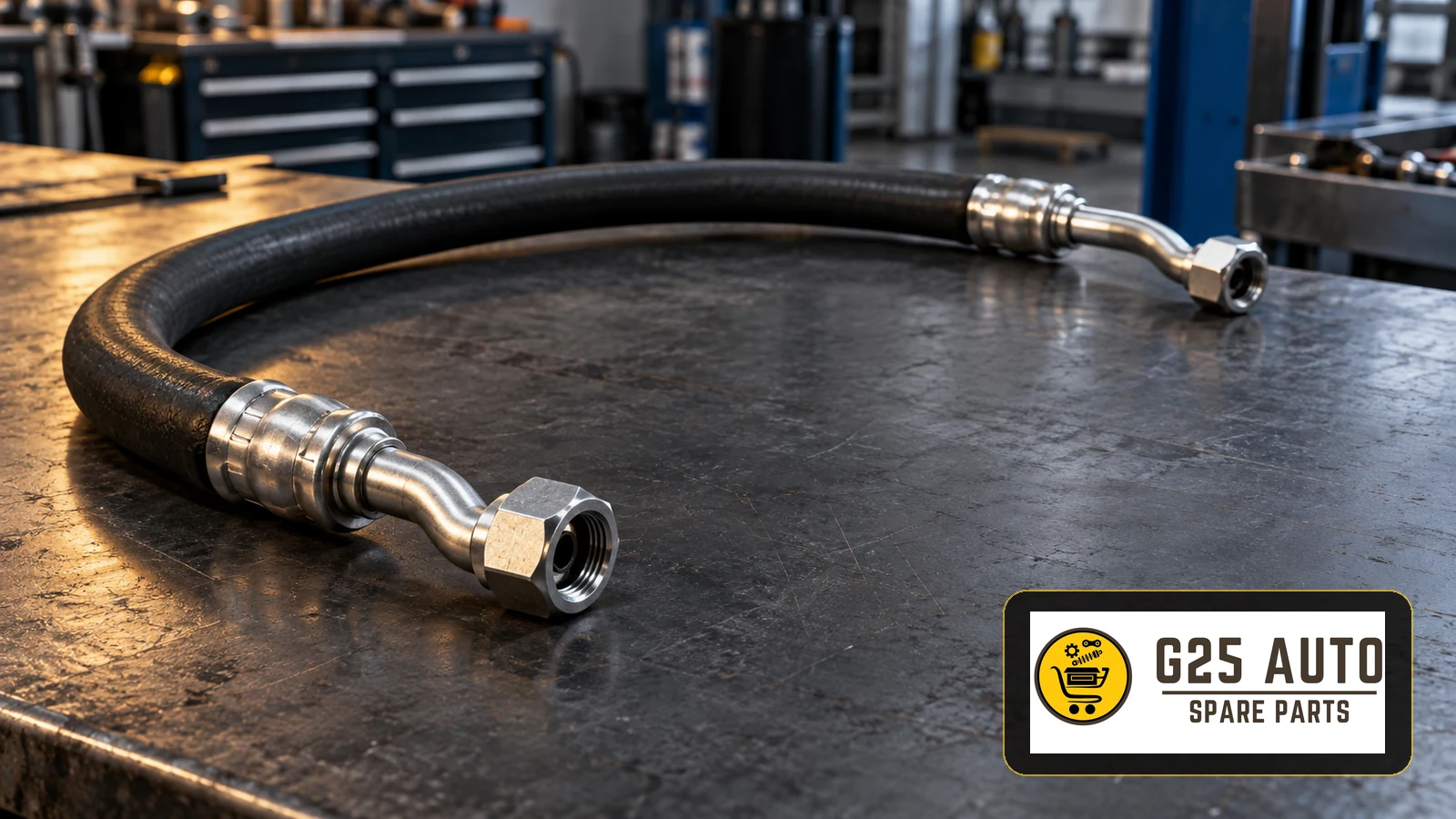
A power steering pressure hose should be replaced when a qualified workshop confirms damage, leakage or restriction and identifies the correct replacement assembly. Heavy steering, noise or falling fluid level justify investigation, but they do not identify the hose as the cause on their own. For European and Balkan workshops, distributors and fleet buyers, the priority is to connect a documented diagnosis with an application-specific parts enquiry before authorising an order.
Identify the pressure line before requesting a quotation
In a hydraulic steering system, the pressure line carries fluid from the pump to the steering gear. The return circuit serves a different role. Identify the circuit from the vehicle documentation rather than ordering a hose by appearance or assuming that every steering system has the same arrangement.
Ask the workshop to state whether the requirement is a complete pressure-line assembly, a return line or another documented service component. In a cross-border enquiry, attach photographs of the installed route and both connections alongside the component reference. This helps a supplier understand the request when terminology differs between languages.
Record the steering system type before building a stock list. A catalogue description for hydraulic steering should not be applied to an unrelated system simply because the vehicle model name matches.
Separate warning signs from a confirmed hose defect
Leaks, surface damage and contamination
Have the technician document where fluid originates and which component is damaged. A wet connection, damaged hose section and leak from a neighbouring component require different repair decisions. Include the inspection finding in the order record rather than treating a photograph of fluid residue as a complete diagnosis.
CARDONE’s power steering hose bulletin describes internal deterioration that can release debris and restrict flow, alongside external hose and coupling damage. An intact-looking outer cover therefore cannot settle every concern. The bulletin itself refers technicians to vehicle-specific diagnostic instructions; its broad replacement recommendations are not a universal repair rule for every application.
Noise and reduced assistance
CARDONE’s hydraulic steering diagnostic chart lists restricted hoses among several possible causes of reduced assistance. It also identifies pump, fluid and other system factors in steering complaints. Record operating conditions and obtain a workshop diagnosis before purchasing a hose, pump or steering gear on the strength of noise alone.
CARDONE’s guidance on air entering through defective hoses discusses foaming and noise associated with a defective return-side hose. This is a useful distinction: those symptoms do not specifically establish a pressure-line fault. The test procedure in that document should not be substituted for the relevant vehicle’s instructions.
A marked change in steering control or an active fluid leak requires professional assessment before the vehicle returns to service. Buyers should request the diagnosis and repair scope, leaving pressure testing and work on the hydraulic circuit to appropriately equipped technicians.
Specify a replacement that can be checked
Provide the VIN, production information, engine identification and steering position, together with any readable reference on the installed assembly. Ask the supplier to reconcile these details with its current application listing and explain any supersession. A VIN, brand name or similar-looking fitting alone does not guarantee compatibility.
Request confirmation of the complete assembly configuration, including connection types, route, mounting points and any application-specific protective or ancillary features. Resolve differences between the catalogue and the installed component before ordering. Do not choose an approximate hose by apparent length or a generic pressure rating.
For an original-equipment or aftermarket quotation, ask for the same evidence: documented application coverage, manufacturer identification, traceability, installation information and warranty terms. Assess each offer against the actual repair requirement. Avoid assuming that one label guarantees fitment, a longer service life or faster delivery.
Agree the repair scope and order contents
CARDONE’s power steering pump technical guidance highlights hose condition, connection cleanliness, the specified fluid and application-dependent bleeding requirements. Its context is pump replacement; it does not provide a single pressure-hose installation procedure for all vehicles.
Ask the workshop to identify the fluid, seals, fasteners and other service items required by the applicable instructions. Have the supplier itemise what the assembly includes and what must be ordered separately. Additional component replacement should follow documented findings rather than an assumption that every leak needs a new pump or rack.
Keep installation settings, fluid quantities, flushing decisions and bleeding methods tied to the vehicle’s service information. Before fleet release, obtain a completion record confirming the prescribed checks and addressing any remaining complaint. A purchase order should make those handover responsibilities clear.
Pre-order checklist
- Separate the driver’s complaint from the workshop’s confirmed defect.
- Identify the steering system and the exact hydraulic line required.
- Supply vehicle details, installed references and useful connection photographs.
- Reconcile catalogue applicability, assembly configuration and supersessions.
- Clarify included seals, fittings and any separately required service items.
- Obtain product identification, installation information and warranty terms.
- Confirm the actual quotation, availability and delivery arrangements in writing.
- Plan receipt inspection and retain the workshop’s completion record.
Frequently asked questions
Does pump noise prove the pressure hose needs replacement?
No. Noise has several possible causes. Ask the workshop to identify the fault before authorising parts.
Can a return hose replace a pressure hose?
Do not substitute one circuit’s hose for another. Obtain an assembly documented for the specific application and line position.
Must the pump be replaced with a leaking hose?
Additional repairs depend on inspection findings and the applicable service instructions. A hose leak alone does not establish pump failure.
Is there a universal replacement interval?
Use the applicable maintenance information and documented condition assessment. A general age or mileage claim does not establish the correct interval for every vehicle.