
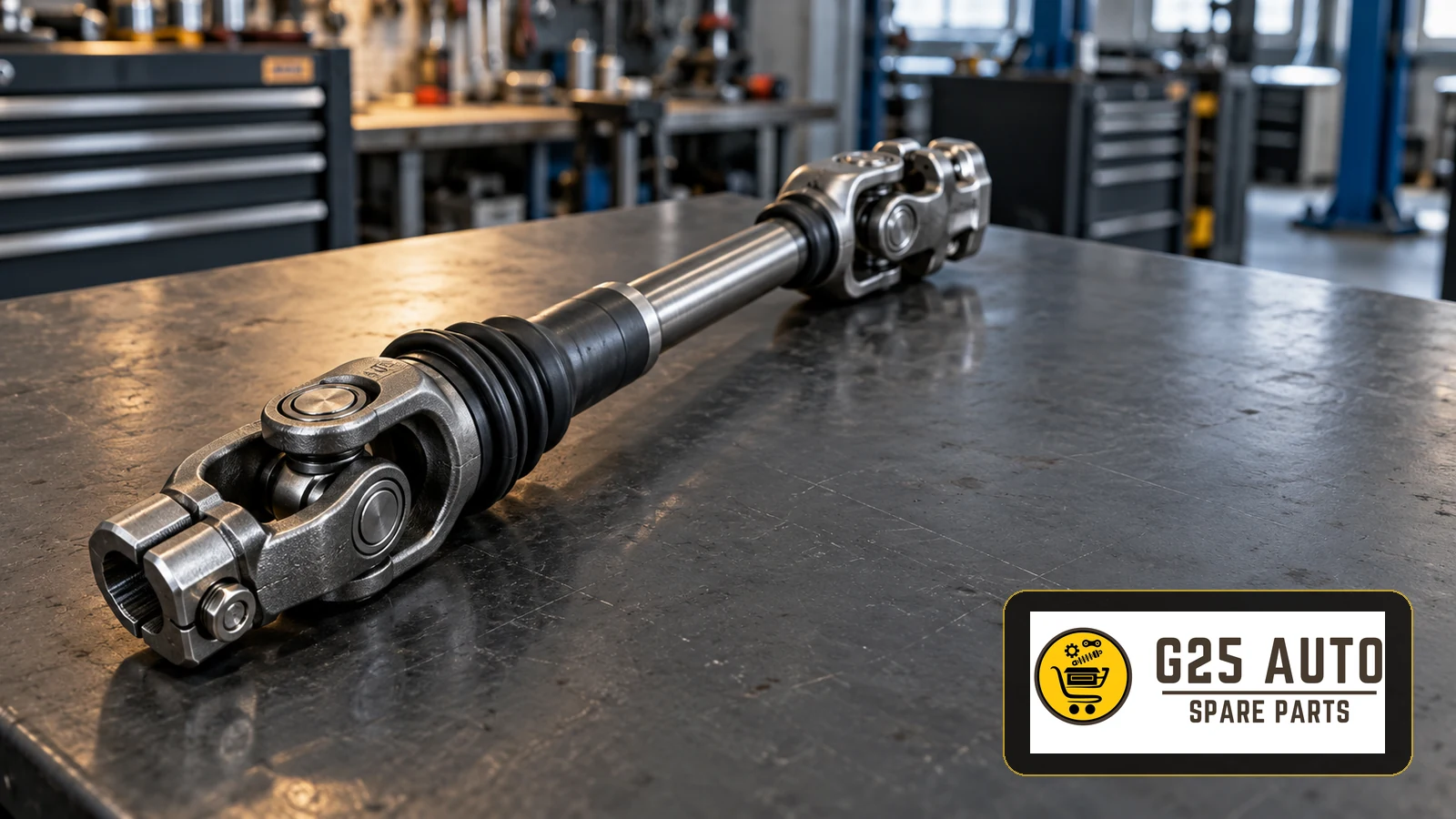
Clunks, free play or notchy steering can justify checking the intermediate steering shaft and its joints, but symptoms alone do not prove that the shaft needs replacement. A qualified workshop should locate the fault, establish the approved repair scope and identify the correct assembly before a parts order is authorised. For European and Balkan workshops, distributors and fleets, the most useful purchasing evidence is a documented defect matched to vehicle and component identification.
Identify the shaft and the joints correctly
The intermediate steering shaft transfers mechanical steering input between the column and steering gear. Universal joints accommodate changes in angle along that connection; the shaft and its joints are related components, rather than interchangeable names. Do not confuse this assembly with a drivetrain propeller shaft, steering rack or complete steering column.
Some assemblies have a telescopic section, while the arrangement and serviceable components depend on the application. Do not assume that every sliding section is a separately repairable crash mechanism or that every universal joint can be replaced independently. Ask the workshop to identify the actual design and the repair permitted by its service documentation.
In a multilingual parts enquiry, include photographs and the component reference alongside the description. Agree whether the request concerns an upper section, lower section, separate service part or complete assembly. A clear enquiry avoids quotations for different repair scopes under the same translated component name.
Distinguish complaints from a confirmed shaft defect
Knocking and free play
Record when a noise occurs: during a direction change, over uneven surfaces or after previous repairs. Ask the technician to state where abnormal movement or noise was found. A driver feeling a knock through the wheel does not establish which component produced it.
CARDONE’s hydraulic steering diagnostic chart includes the intermediate shaft, suspension components and steering gear among possible contributors to free play. Its hydraulic troubleshooting context matters: the list is a reason to investigate the system, not a diagnosis or a universal test sequence.
A historical GM bulletin on lower intermediate shaft noise describes a redesigned shaft for a narrowly defined Colorado and Canyon population after noise is isolated to that component. It illustrates why production applicability and the latest relevant repair information matter. It does not establish a replacement rule for unrelated European or Balkan vehicles.
Stiffness, binding and corrosion
A marked change in steering control requires professional assessment before the vehicle is returned to service. Describe the conditions and any visible damage without asking a buyer to reproduce the symptom by forcing the steering or dismantling the shaft.
Ford’s historical intermediate shaft corrosion recall report documents joint stiffening and possible consequential damage on specific North American vehicles. That application-specific failure mechanism must not be generalised to every rust mark or shaft design. For an individual vehicle, check current manufacturer information and any applicable campaign through the appropriate channel.
Build a verifiable B2B parts enquiry
Start with the VIN, vehicle specification, production details and steering position. Add the installed assembly reference, readable identification and photographs of both connections. Treat this information as evidence for catalogue checking; a VIN or photograph alone is not a blanket guarantee of fitment, especially where previous modifications are possible.
Ask the supplier to reconcile the requested reference with its current application listing and explain any supersession. If the old unit and catalogue disagree, resolve that discrepancy before authorising shipment. Avoid accepting a similar-looking clamp, approximate length or matching model name as sufficient confirmation.
Request an itemised quotation distinguishing the shaft, separately required fasteners, seals or other documented service parts. Ask what is included, which installation information accompanies the product, and how traceability and warranty claims are handled. Obtain actual availability and delivery terms for the order; do not infer them from brand reputation or a general catalogue description.
Keep installation decisions application specific
The workshop should obtain the applicable removal, installation and inspection instructions before work begins. Requirements for steering position, connection engagement, fastener replacement and tightening must come from that information. A general purchasing article cannot supply those specifications.
CARDONE’s electric steering technical guidance warns that uncontrolled steering wheel rotation with the intermediate shaft disconnected can damage the clock spring. It also directs technicians to original equipment instructions and relevant bulletins. Use this as a planning consideration, not a substitute for the vehicle’s prescribed procedure.
Do not assume that shaft replacement always requires calibration, always avoids alignment checks or can be completed by adding lubricant. Have the workshop determine the necessary checks from the actual repair scope and service information, then document the result before fleet release.
Pre-order checklist
- Record the complaint separately from the technician’s confirmed defect.
- Confirm vehicle identity, production details and steering position.
- Identify the exact shaft section and permitted repair scope.
- Reconcile installed references, catalogue applicability and supersessions.
- Clarify assembly contents and any separately required service parts.
- Obtain installation documentation and product traceability details.
- Confirm the quotation, availability, delivery and warranty terms in writing.
- Plan receipt inspection and retain the workshop’s completion record.
Frequently asked questions
Does a steering clunk mean the intermediate shaft is faulty?
No. The workshop must locate the source and distinguish the shaft from other steering or suspension components before replacement is approved.
Can the universal joint be purchased separately?
Only where the application documentation and relevant parts listing provide that repair option. Do not assume a complete shaft can be dismantled for joint replacement.
Is aftermarket branding enough to confirm suitability?
No. Request documented application matching, traceability and the relevant product information. A broad quality or certification claim does not establish compatibility with a particular vehicle.
What should the fleet retain after replacement?
Keep the diagnosis, supplied component reference, supplier documents and workshop completion record together. Record any required follow-up checks and unresolved concerns before releasing the vehicle.