
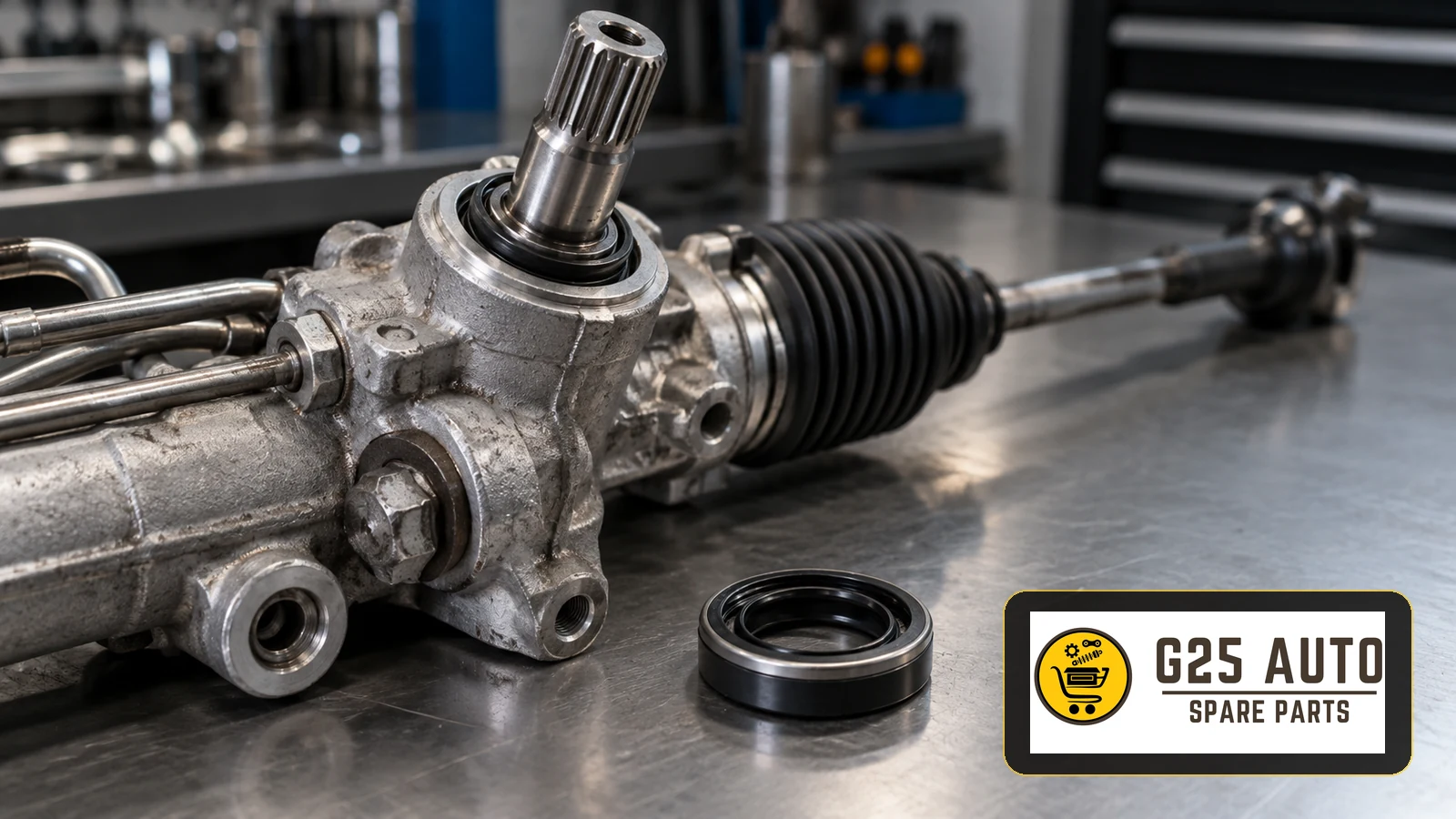
A steering gear input shaft seal retains hydraulic fluid where the steering input enters the gear. Oil around this area does not, by itself, prove that the seal has failed: the workshop must identify the fluid source and confirm the permitted repair. For European and Balkan workshops, distributors and fleet buyers, the purchasing decision is whether the identified gear accepts a documented seal repair or requires another approved repair scope.
Identify the steering system before discussing seals
Start with the actual steering arrangement. A hydraulic rack, a hydraulic steering box and an electrically assisted steering assembly should not be grouped under one generic seal enquiry. An electric pump can supply a hydraulic system, while a steering system with purely electric assistance does not have the same hydraulic fluid circuit. Establish what is fitted before interpreting a wet housing or requesting a kit.
Also distinguish the input shaft seal from an external dust seal, a rack bellows, a pipe connection seal and an output shaft seal. These descriptions identify different locations and functions. A rubber component visible near the input shaft is not necessarily the hydraulic sealing element that needs repair.
Record the gear identity as well as the vehicle
Provide the VIN, production details, steering configuration and legible identification from the installed steering gear. Record whether the vehicle is left-hand or right-hand drive and whether the gear has previously been replaced. Use these details together with current application information; neither a VIN lookup nor an old reference alone is an unconditional fitment guarantee.
Confirm an active leak at the correct location
Useful observations include fresh fluid near the input, repeated reservoir level loss and drips beneath the vehicle. Record when these appear and whether recent work preceded them. A wet exterior, steering noise or heavier steering can justify investigation, but none independently identifies an input seal failure.
TRW’s input shaft seal service procedure explains that grease migration can resemble leakage on its specified commercial steering gears. It also identifies hoses, fittings and the reservoir as possible sources of fluid reaching this area. This is a reason to establish the origin of contamination, not to dismiss fluid loss on another application as normal.
The technician should follow the applicable diagnostic method and document where fresh leakage actually begins. Ask for a clear finding rather than a photograph of an already oil-covered assembly. Do not prescribe a universal pressure test, steering manoeuvre or operating temperature from a general parts article.
Keep symptoms separate from the order description
CARDONE’s power steering diagnostic chart lists multiple possible causes for noise, poor assistance and external leakage. It supports investigating the system rather than replacing one seal solely because a symptom seems familiar. Its chart is diagnostic guidance, not repair authorisation for an unidentified vehicle.
Arrange prompt professional assessment of a suspected leak. If assistance or steering control is impaired, keep the vehicle out of service pending assessment and arrange suitable recovery. Repeated topping-up should not become the fleet’s substitute for locating and resolving fluid loss.
Decide whether a seal repair is supported
A kit listing and a permitted repair procedure answer different questions. Confirm both for the installed gear before ordering. A supplier offering a loose seal does not establish that the vehicle manufacturer permits a workshop seal replacement or that the rest of the assembly is serviceable.
The TRW procedure is expressly limited to named commercial steering gear series and trained technicians. Its existence demonstrates a defined repair route for those gears; it does not make on-vehicle seal replacement universal. The document also requires investigation of excessive heat where the removed seal shows heat damage. Replacing a seal without resolving an identified underlying fault can leave the repair incomplete.
Ask the workshop to state whether it proposes a documented seal repair, specialist assessment or replacement of the steering assembly. Obtain that decision before comparing quotations. Avoid treating a seal kit and a complete remanufactured or new gear as directly equivalent packages.
B2B enquiry and receiving checklist
- Record vehicle identity, production details and steering configuration.
- Capture installed gear markings and any known replacement history.
- Obtain the workshop’s confirmed leak location and diagnostic finding.
- Confirm the supported repair scope and applicable service information.
- Check the supplier’s application listing and reference supersessions.
- Verify exactly which seals, retainers and related items are included.
- Request product identification, traceability and installation information.
- Resolve discrepancies between the order, packaging and workshop requirement before fitting.
Compare evidence for the actual offer
For original-equipment and aftermarket proposals, compare documented application, repair scope, package contents and technical support. Request written commercial terms for the specific order. Do not infer material suitability, service life or complete equivalence from a brand name, a generic certification claim or a photograph.
A cross-border enquiry should use the same component description throughout the quotation, delivery paperwork and workshop job record. Identify the input seal location clearly so translated terms such as pinion seal or steering box seal do not silently change the requested component.
Plan installation and repair verification
Agree responsibility for the repair before parts arrive. The qualified technician should obtain the application-specific requirements for access, shaft connection, seal installation, retaining components, fluid and final checks. Use that information to determine whether specialist equipment, additional parts or a different repair route is required.
For fleet records, retain the diagnosed fault, installed product identity and completed inspection report. The workshop should verify leak resolution and correct steering operation under the applicable procedure before release. Any required bleeding, steering-angle work or alignment assessment belongs to that procedure rather than a blanket seal-replacement rule.
Frequently asked questions
Does oil around the input shaft prove a failed seal?
No. Establish the fluid source; nearby connections or application-specific grease migration can complicate the diagnosis.
Can every input seal be replaced separately?
No. Confirm the permitted repair for the installed gear and the correct kit before purchasing.
Is matching the old seal’s appearance sufficient?
No. Use documented application information and the confirmed repair specification rather than visual similarity alone.
Is there a standard seal replacement interval?
Use the vehicle’s maintenance requirements and workshop findings. Do not apply a universal mileage, promised lifespan or repair time.