
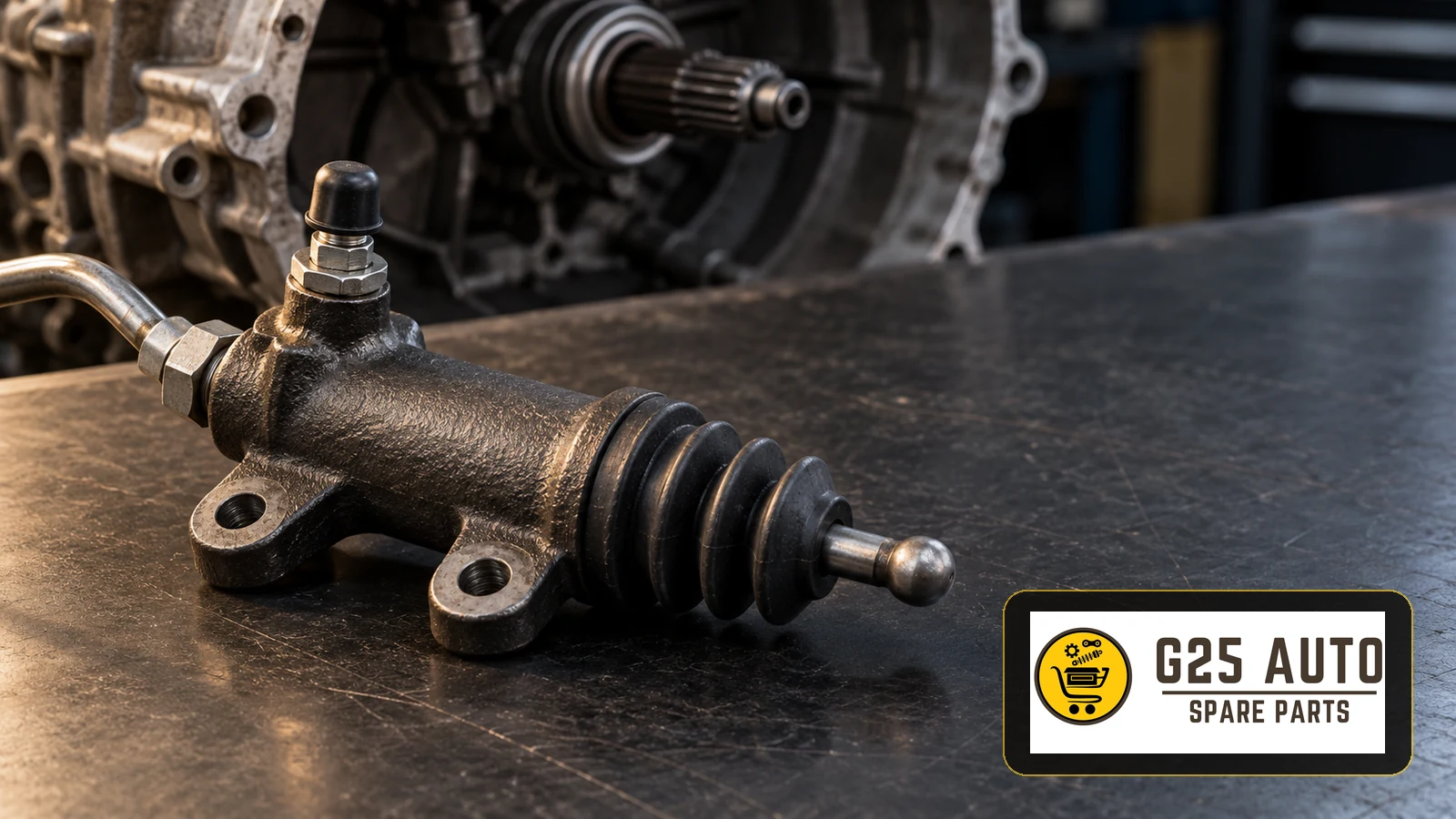
A soft clutch pedal, incomplete disengagement or a pedal that fails to return calls for inspection of the hydraulic release system before a slave cylinder is ordered. Identify whether the vehicle uses an external slave cylinder or a concentric slave cylinder, confirm the fault through the applicable diagnostic procedure, and select the replacement against the exact vehicle and transmission application. Symptoms alone do not establish which component has failed. For workshops and distributors across Europe and the Balkans, a documented diagnosis and parts request provide a sound basis for the repair.
Identify the clutch release arrangement
The master cylinder receives pedal movement and transmits hydraulic pressure to the slave cylinder. In a conventional arrangement, the slave operates a release lever. A concentric slave cylinder, commonly called a CSC, combines the hydraulic cylinder and release bearing in one unit. ZF describes these arrangements in its clutch actuation overview.
Establish the arrangement from the vehicle documentation before estimating access or ordering parts. An external cylinder and a CSC are different assemblies; a request saying only “clutch cylinder” is incomplete. Keep the master cylinder, slave cylinder, release bearing and associated pipework clearly distinguished in the job record.
Separate reported symptoms from confirmed findings
Changed pedal feel and difficult disengagement
ZF’s hydraulic clutch bleeding guidance identifies altered pedal travel, difficult disengagement and imprecise pedal feel as possible effects of trapped air. This is a reason to investigate the complete system, rather than treating those symptoms as proof of a defective slave cylinder.
Record when the symptom occurs, whether the pedal returns normally and whether previous hydraulic work preceded the complaint. Give the technician the driver’s observations without converting them into a parts diagnosis. Where normal clutch operation cannot be established, arrange assessment before further driving or a road test.
Fluid loss and visible wetness
Ask for an inspection record covering the relevant reservoir, master cylinder, hydraulic lines, connections and slave-cylinder area, using the vehicle’s diagnostic instructions. Record the location of visible wetness and the observed fluid level. Do not identify a fluid or its source from colour alone, and do not describe a stain near the gearbox as confirmed slave-cylinder leakage without investigation.
If access prevents confirmation, state that limitation in the quotation. Keep a suspected hydraulic problem distinct from a confirmed cylinder fault or a separate mechanical release problem. Replacing the component named in the initial enquiry should not substitute for completing the diagnosis.
Specify the replacement and its connections
Build the enquiry around the vehicle identification, transmission details and catalogue application. Add the existing reference when readable, together with labelled photographs of the assembly and connection. Use these as supporting identification evidence; neither an old fitted part nor visual similarity guarantees the proposed replacement is correct.
Check the current catalogue and installation information for supersessions, connector arrangements, supplied seals and any separately required hardware. ZF’s December 2018 service information on a CSC with a modified plug connection illustrates why this matters: that specific replacement uses a revised connection and instructions concerning old adapters and clips. It is an example of a documented change, not permission to alter any clutch hydraulic connection.
Ask the supplier to identify the proposed reference and its documented application. Keep questions about kit contents separate from fitment confirmation. A brand name or quality-system certificate alone does not answer whether a particular cylinder suits the identified vehicle.
Workshop and distributor order checklist
- Record vehicle identification and the configuration details required by the parts catalogue.
- Confirm the transmission application and the external-cylinder or CSC arrangement.
- Attach the diagnostic findings, including any limits on inspection access.
- Record the existing reference and check current replacement or supersession notes.
- Verify the hydraulic connection, mounting arrangement and documented installation requirements.
- Confirm supplied seals, clips, adapters and other items against the repair scope.
- Obtain the applicable fluid specification and bleeding procedure before installation.
- Retain supplier confirmation and resolve outstanding application questions before fitting.
When a regional distributor and workshop exchange an enquiry in different languages, retain the catalogue reference alongside the agreed component description. Record proposed substitutions explicitly and request technical clarification where the available information conflicts.
Plan installation, bleeding and handover
Use the current vehicle and component instructions for access, removal, installation and tightening. Obtain the requirements for the actual assembly instead of applying a generic cylinder replacement sequence. This guide supplies no universal torque, bleeding pressure, pedal sequence or repair duration.
ZF calls for bleeding after hydraulic component replacement according to vehicle instructions, using approved fluid and equipment with careful cleanliness. Its guidance also warns that inappropriate pedal operation during bleeding can overextend the cylinder. Select the specified method for the system being serviced; do not improvise a pumping sequence.
At handover, document the fitted reference, completed bleeding procedure, leak checks and functional checks required by the repair information. Record whether the original complaint has been resolved. If pedal return or disengagement remains abnormal, continue the diagnostic process instead of closing the job because the new cylinder has been installed.
Frequently asked questions
Does a soft pedal prove the slave cylinder has failed?
No. Record the symptom and investigate the hydraulic system, including possible trapped air, before identifying the failed component.
Are external slave cylinders and CSCs interchangeable?
They are different release arrangements. Select the documented assembly for the exact vehicle and transmission application.
Should the master cylinder also be replaced?
Determine the repair scope from the diagnosis and applicable instructions. Do not turn a slave-cylinder enquiry into an unsupported blanket replacement rule.
Can every clutch system use the same bleeding method?
No. Obtain the vehicle and component procedure, including approved fluid and equipment, and follow its requirements.