
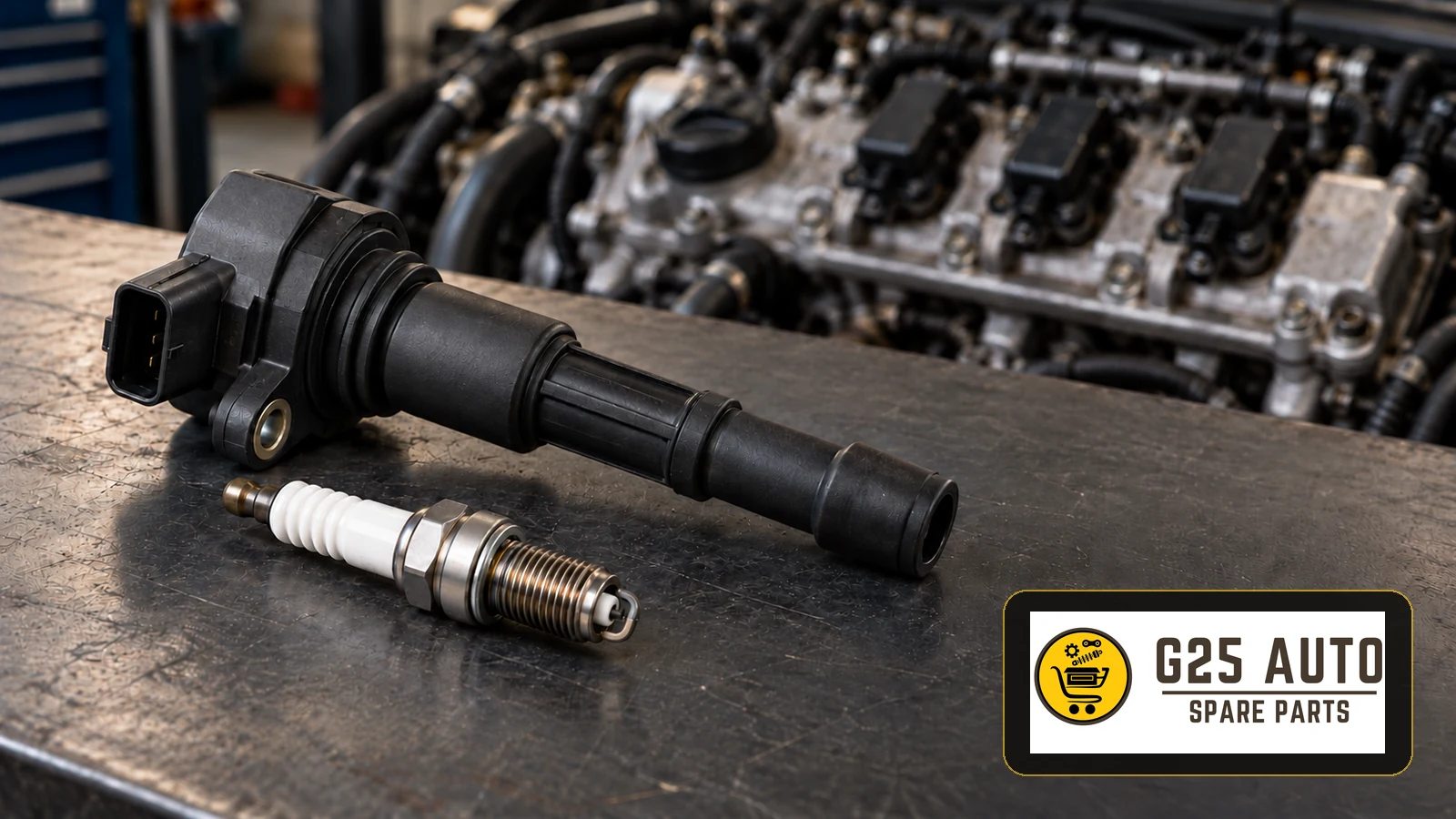
An ignition coil supplies the high voltage needed for a petrol engine’s spark plugs to ignite the mixture. A failing coil can cause misfiring, difficult starting or poor acceleration, but those symptoms do not identify the faulty component by themselves. For European and Balkan workshops and parts distributors, the reliable approach is to diagnose the cause, identify the exact ignition system and verify the replacement in current application data before ordering.
Identify the ignition system first
Ignition coils use electromagnetic induction to generate the voltage required for the spark. Depending on the engine, a coil may feed a distributor, form part of a shared coil pack or sit directly over a spark plug. A pencil-shaped coil describes a physical design; it does not establish a separate electrical system or interchangeability. HELLA’s coil overview illustrates the variety of constructions.
Start the job record with the actual engine and fitted assembly. A model badge, registration year or photograph alone can leave several possibilities. For vehicles moving between European markets, record the original vehicle specification as well as the country where the enquiry is made. Do not use diesel glow-plug applications as examples of spark-ignition coil fitment.
Separate symptoms from a confirmed coil fault
Record the complaint and inspect the surroundings
Ask when the fault occurs: at starting, at idle, when warm or under load. Save the diagnostic report and available operating data before clearing anything. Record whether the concern is repeatable and what previous work has been performed. This gives the technician and supplier a common account of the problem instead of a request based only on an illuminated warning lamp.
Inspect accessible housings, boots, connectors and wiring for damage, corrosion, contamination and signs of electrical tracking. Check the spark-plug well and investigate oil or water entry. DENSO’s fault-finding guidance emphasises identifying the underlying cause so that a replacement is not exposed to the same problem.
Use tests suited to the fitted design
A misfire code identifies a combustion problem, not automatically a defective coil. Supply, ground and command checks must use the correct wiring information. NGK’s direct-coil diagnostic case study also explains that a command pulse alone does not prove a satisfactory high-voltage output. Its pin assignments and measured values belong to the illustrated application and should not be transferred to other engines.
Resistance measurement is not a universal pass-or-fail test: internal electronics or a high-voltage diode can limit what an ohmmeter can establish. Use the manufacturer’s specified test and suitable equipment. Where permitted, exchanging identical individual coils between cylinders can help investigate a repeatable fault; record positions and results. A fault that stays on the same cylinder requires further investigation of ignition, fuel delivery and mechanical condition.
HELLA’s diagnostic guidance covers these testing limits and the hazards of live ignition circuits. Leave testing to trained personnel. Do not disconnect coils or spark-plug connections while the engine runs, or improvise an exposed-spark test.
Build a clear replacement-parts enquiry
Provide the VIN, engine identification, production information and legible references from the fitted component. Check these against the current catalogue, including supersessions and application restrictions. DENSO’s selection guidance highlights differences in coil construction and connectors and recommends catalogue cross-referencing.
Ask the supplier to confirm the specific proposed reference, rather than simply accepting “fits this model”. Include photographs of the connector, mounting and boot where identification remains uncertain. Physical resemblance supports a check but cannot establish electrical compatibility. If catalogue information and the installed part disagree, resolve the discrepancy before opening or fitting the replacement.
For original and aftermarket products alike, request documented application information and traceable product identification. Confirm what the supply unit contains and whether boots or other associated items are included. Record any warranty terms actually offered. A brand category, certificate or longer warranty statement alone does not prove suitability for the vehicle.
Workshop and purchasing checklist
- Record the vehicle, engine, production information and original market specification.
- Save the fault report, operating conditions and previous repair history.
- Inspect the coil, connector, wiring, spark plug and plug well as applicable.
- Complete the specified tests and document the evidence for replacement.
- Verify the proposed reference, supersessions and catalogue restrictions.
- Confirm the supplied assembly and any separately required service items.
- Plan access, isolation, tools and installation using vehicle instructions.
- Record the final functional check and any unresolved symptoms.
Install carefully and close the diagnostic loop
Use the vehicle procedure for electrical isolation, access and removal. Allow the engine to cool and protect the work area from contamination. Follow specified alignment and fastening instructions; forcing a misaligned coil can damage its connection to the spark plug. Apply any lubricant or compound only where the relevant instructions specify it.
Address identified leaks, connector faults or related damage before returning the vehicle to service. Restore disturbed connections and components. After preserving the initial diagnostic evidence, clear faults as directed and perform the specified functional checks. Compare the result with the original complaint and retain the final scan report. A smooth idle alone does not resolve a fault reported only under different operating conditions.
Frequently asked questions
Should every coil be replaced when one fails?
Check the vehicle repair guidance, relevant technical bulletins and condition of the other components. Document the reason for the replacement scope; neither a single-coil repair nor a complete set is a universal rule.
Is there a fixed replacement mileage?
Use the applicable maintenance and repair information. Do not impose a universal distance or replace serviceable coils solely because another vehicle needed them.
Does an identical connector prove compatibility?
No. Verify the documented application and proposed part reference. Matching connector shape does not establish the required electrical characteristics or correct mounting.
Is coding always needed after replacement?
Check the applicable service procedure for required diagnostic functions. Do not promise coding, adaptation or its absence based on vehicle brand or price category.