
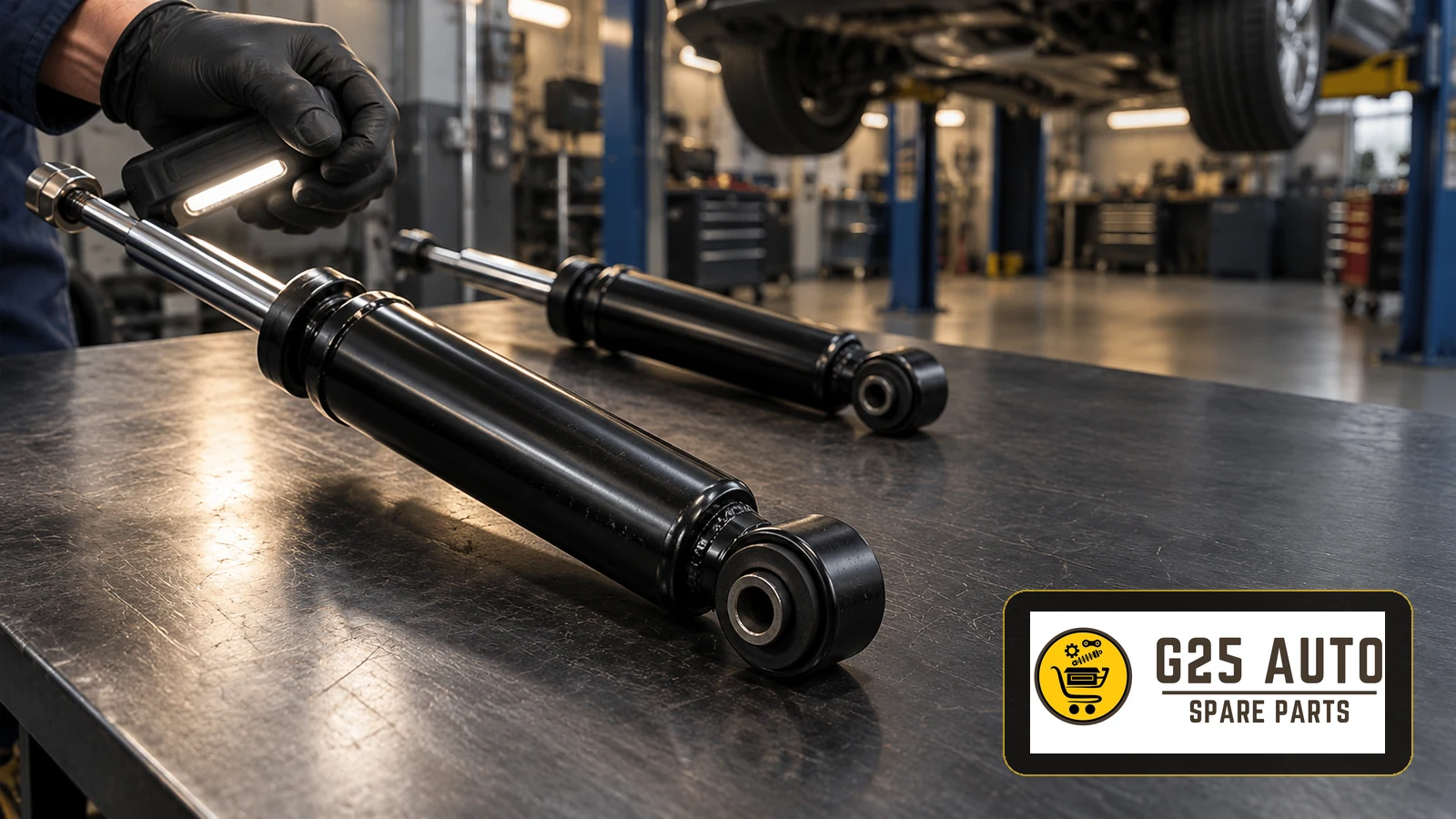
Replace shock absorbers when a professional inspection confirms damage or inadequate damping, using the relevant vehicle and component guidance to plan the repair. Mileage, driver complaints and oil marks are useful evidence, but no single observation establishes every replacement decision. For European and Balkan workshops and fleet buyers, the priority is a documented assessment, the correct suspension application and a complete repair plan before parts are ordered.
Understand the component before setting a replacement date
A suspension spring accommodates movement and supports the vehicle; the damper controls the resulting oscillation. The tyre, spring and damper work together, so a ride complaint should be assessed across the suspension. KYB’s suspension overview describes this relationship and the warning signs that justify a workshop check. A strut also has a structural role in the suspension, making correct identification essential.
For the job record, distinguish a separate shock absorber from a strut or a supplied assembly. Record which axle is affected and whether the vehicle has special suspension equipment. That information should follow the enquiry from the technician to the buyer and supplier, rather than being reconstructed after a part arrives.
Use symptoms to open an inspection
Record what changed and when
Ask about repeated bouncing over uneven surfaces, increased body movement, instability, steering vibration and unusual tyre wear. Note the load, road conditions and whether the concern developed gradually or followed an impact. These observations direct the inspection; they do not prove that the damper alone is responsible. Tyres, springs, mountings and other suspension components can contribute to similar complaints.
Fleet records are particularly useful when several drivers use the same vehicle. Keep the complaint in the driver’s own words, alongside the inspection findings, so a vague report such as poor ride becomes a traceable workshop decision. Avoid promising that a damper change will cure an unidentified noise.
Separate physical damage from normal surface traces
Inspect accessible mounting brackets, the body and piston rod for damage. KYB’s diagnostic guidance identifies bent or scored rods and broken brackets as mechanical failure signs. It also explains that damping can deteriorate without an obvious external leak. A dry exterior therefore does not establish serviceability.
A light oil film needs a different assessment from clear fluid loss. ZF’s leakage guidance distinguishes normal lubricating mist from substantial oil traces and warns that road contamination can mislead the inspection. Examine a dry component and follow the applicable assessment procedure. Where the evidence remains uncertain, record the uncertainty and the required follow-up instead of converting every mark into a replacement recommendation.
Decide when the vehicle needs intervention
Consult the vehicle maintenance information and the replacement manufacturer’s guidance. Do not turn a general mileage recommendation into a guaranteed service life or a deadline that permits continued use despite a defect. Equally, a high odometer reading alone does not describe the condition of every component. ZF’s workshop replacement guide explains that wear can develop gradually as drivers become accustomed to changed handling.
Combine the reported behaviour, physical findings and prescribed diagnostic checks. A casual body bounce check is insufficient to approve the whole suspension. Any dynamic assessment should follow a professional procedure appropriate to the vehicle’s condition; avoid improvised emergency braking as a diagnostic shortcut. If the findings raise a safety concern, the workshop should assess whether the vehicle can be used before the repair.
For fleet planning, separate the inspection outcome from the commercial decision. Record the defect and recommended work first, then agree vehicle downtime, parts sourcing and authorisation. Scheduling should reflect the assessment rather than an assumed delivery date or a universal replacement interval.
Turn the diagnosis into a complete parts enquiry
Plan damper replacement as an axle pair to maintain balanced damping. Inspect the associated springs, mountings, bearings where fitted, dust covers and bump stops; define the related work using their condition and the applicable instructions. A quote for one bare damper is a different repair scope from a quote that includes protection parts and mounting components.
For genuine and aftermarket options alike, request a documented application match. Use the VIN and vehicle specification alongside catalogue information, existing markings and the actual installation. Resolve standard, sport or electronically controlled suspension requirements before accepting an alternative. Familiar branding, a similar shape or a broad model description does not establish suitability.
Workshop and distributor ordering checklist
- Record the VIN, production details and suspension equipment relevant to identification.
- Specify the axle, position and whether the requirement is a damper, strut or assembly.
- Attach useful photographs and legible existing markings for cross-checking.
- Confirm the proposed reference and exclusions against current manufacturer application data.
- State the axle-pair requirement and list exactly what each package contains.
- Include the agreed protection parts, mounting components and required fitting hardware.
- Request fitting information and identify any vehicle-specific completion procedures.
- Obtain written quotation, availability, warranty and return terms before ordering.
Keep unresolved identification questions visible on the enquiry. The buyer should obtain clarification before approving a substitution, rather than treating a supplier’s general description as evidence of fitment. Commercial terms should be confirmed for the actual order; they should not be inferred from a generic comparison between genuine and aftermarket parts.
Include installation and release in the repair plan
Use trained personnel and suitable equipment for spring-loaded strut work. Follow the vehicle and component instructions for assembly order, orientation, preparation, hardware replacement, tightening position and torque. Protect the polished piston rod. KYB’s fitting guidance explains the damage caused by gripping that surface with pliers and by impact tightening the upper rod nut.
Restore any disturbed hose and sensor-wire attachments. Complete the alignment checks and any electronic procedures specified for the vehicle. Record fitted references and final checks, then carry out an appropriate controlled function assessment. Investigate new noises or instability before releasing the vehicle rather than assuming they will disappear with use.
Frequently asked questions
Is there one replacement mileage for every shock absorber?
No. Use the applicable maintenance guidance and inspection findings; do not apply one interval as a universal service-life guarantee.
Does a small oil mark mean immediate replacement?
Not necessarily. Distinguish normal misting and contamination from meaningful leakage using the manufacturer’s assessment guidance.
Should the order cover both sides of the axle?
Plan a matched axle pair and define the associated parts and work before approving the order.
Can an aftermarket part be selected by appearance?
No. Confirm the exact application and suspension specification through current manufacturer data, supported by vehicle and component identification.