
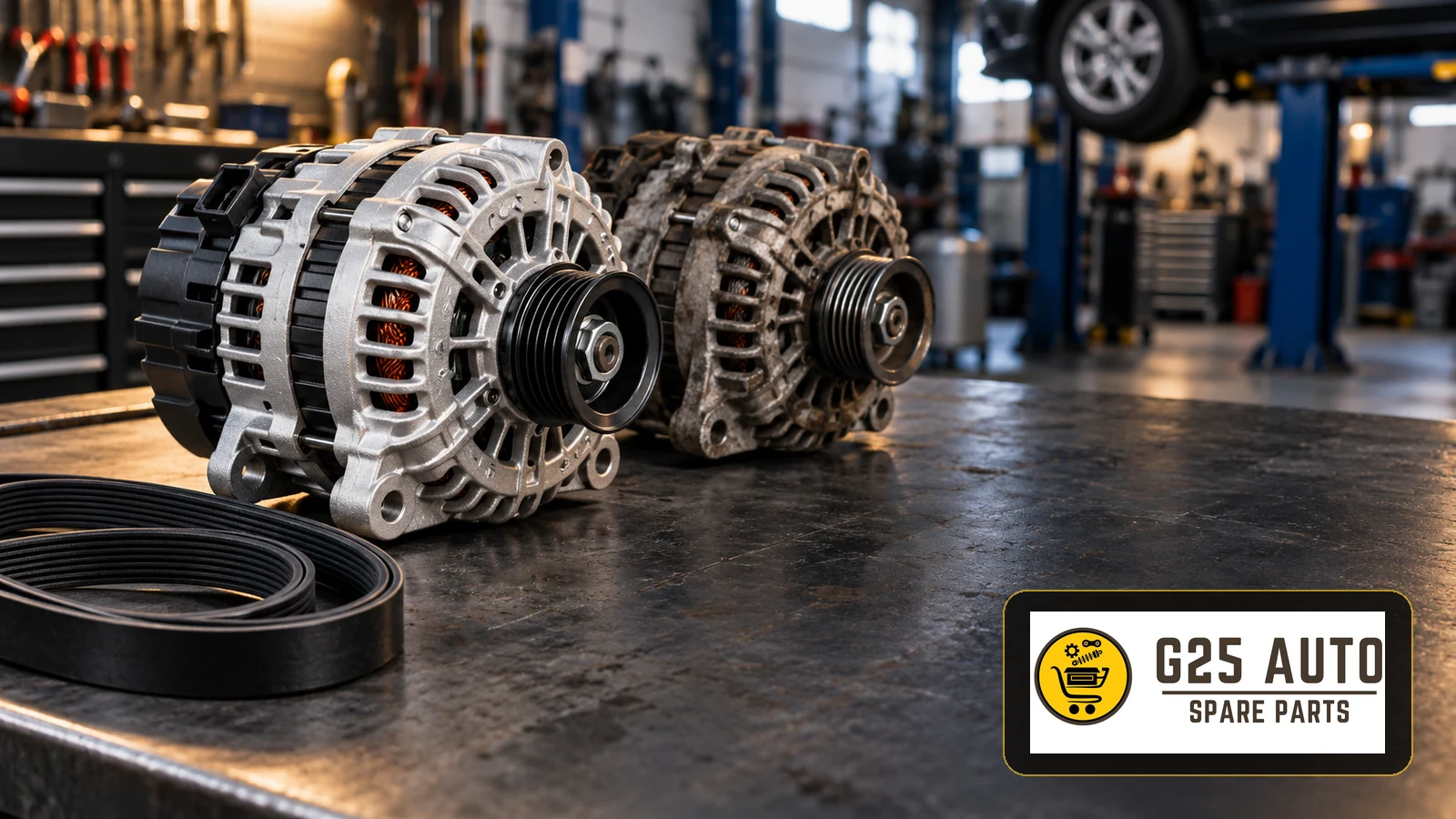
An alternator converts engine power into electricity to support the vehicle’s electrical consumers and recharge its battery. A charging warning, repeated battery discharge or abnormal belt-area noise calls for a charging-system diagnosis before ordering a replacement. For European and Balkan workshops, the buying decision should combine a confirmed fault with vehicle-specific identification, electrical control compatibility and a physical comparison of the replacement.
What the alternator does
In a conventional belt-driven charging system, the rotor turns inside the stator and the generated alternating current is rectified for the vehicle’s direct-current electrical system. Regulation controls the output. The battery can supplement electrical demand when alternator output is insufficient; a running engine does not mean the battery is continuously receiving charge.
Why a single voltage reading can mislead
Modern energy management can vary charging according to operating conditions and battery information. A reading taken at idle is therefore not a universal pass-or-fail test. Identify the charging architecture, fitted battery type and manufacturer’s diagnostic conditions before interpreting measurements. On a managed system, the workshop may need to compare requested charging with actual response and investigate communication faults. HELLA explains these relationships in its alternator regulator guidance.
Symptoms that deserve investigation
Charging warnings and repeated discharge
A warning lamp that remains illuminated while the engine runs, flickering lights or repeated starting difficulty can accompany a charging fault. They do not identify the alternator as the failed component. Battery condition, connections, protective devices and control wiring can produce overlapping complaints. Record whether the problem occurs after standing, during a journey or when electrical consumers are switched on.
Noise and intermittent operation
Whining, squealing or rattling around the auxiliary drive needs careful localisation. Belt condition, alignment, tensioner operation, pulley behaviour and alternator bearings require assessment. Avoid diagnosing an internal bearing solely from a sound heard near the unit. DENSO’s symptom-led fault guide describes why external causes should be checked before replacement.
If charging fails during a journey, follow the vehicle’s warning instructions and arrange assistance where necessary. There is no dependable remaining driving distance to quote. Smoke, arcing, severe belt damage or overheated wiring requires the vehicle to be stopped safely and professionally assessed.
A workshop diagnosis before a purchase order
- Document the complaint. Record warnings, operating conditions, recent repairs and any added electrical equipment.
- Assess the battery. Check its condition and state of charge using a suitable procedure. Prepare it as specified before charging-system tests.
- Inspect the drive and connections. Look for belt damage, contamination, loose terminals, damaged insulation and compromised ground paths with the vehicle safely prepared.
- Test the complete circuit. Use the manufacturer’s loaded test procedure and voltage-drop checks on both output and return paths. A cable fault can prevent effective charging even when the alternator can generate output.
- Check control and output. Where applicable, inspect diagnostic codes and charging commands. Use suitable test equipment and application-specific criteria to distinguish a control fault from an internal alternator fault.
DENSO’s charging-circuit troubleshooting guidance supports checking the battery, wiring and ground connections. Keep the test conditions and findings with the job record so the parts buyer can understand why replacement is justified.
Selecting a replacement for the actual vehicle
A vehicle model name or a similar-looking housing is insufficient for a trade order. Build an identification file using the VIN, engine code, production information and the installed unit’s readable manufacturer references. Use these together with a current application catalogue; a previously fitted unit may itself be incorrect.
Ordering checklist
- Confirm the catalogue application and any documented reference supersession.
- Verify the specified electrical system and required output rating.
- Confirm regulator and vehicle communication compatibility.
- Compare mounting points, housing orientation and available clearance.
- Check pulley type, belt profile, alignment and offset.
- Compare connector arrangement and main output-terminal position.
- Record whether the offered unit is new or remanufactured.
- Obtain written warranty terms and any core-return conditions.
Ask the supplier to resolve conflicting references before authorising the order. Photographs of the label, mounting points and connectors can support the enquiry. They complement catalogue confirmation; they do not establish compatibility by themselves.
OE, aftermarket and remanufactured options
Compare documented suitability and supply terms for each specific offer. A brand category alone does not establish fitment, service life, warranty length or availability. For a distributor serving several Balkan markets, retaining the confirmed application and supplier response creates a clearer record for the receiving workshop and any later claim.
Installation and the final charging check
Follow the vehicle-specific isolation and installation instructions. Never disconnect the battery with the engine running to test charging. Correct the original cause, including wiring damage, contamination or drive problems, before returning the vehicle to service.
Use the specified fasteners, tightening procedure and belt setup, then verify routing and clearance. Recheck charging under the required conditions and confirm that the original complaint is resolved. DENSO’s replacement guidance highlights physical comparison, alignment and verification against vehicle specifications.
Frequently asked questions
Does a flat battery prove the alternator has failed?
No. Battery deterioration, unwanted electrical drain and circuit faults are other possibilities. Diagnose the complaint before choosing a part.
Can a higher-output alternator be substituted?
Only when the application documentation explicitly supports the replacement. A higher rating alone does not establish mechanical or electronic compatibility.
Must the complete alternator always be replaced?
Not always. A specialist may identify a repairable fault where the unit design and approved repair procedure allow it. DENSO’s diagnosis guidance discusses bench assessment and regulator repair. Base the decision on test results and the proposed repair’s scope.
Is there a universal replacement mileage?
No single mileage establishes the condition of every alternator. Use the vehicle’s service information, inspection findings and confirmed performance.