
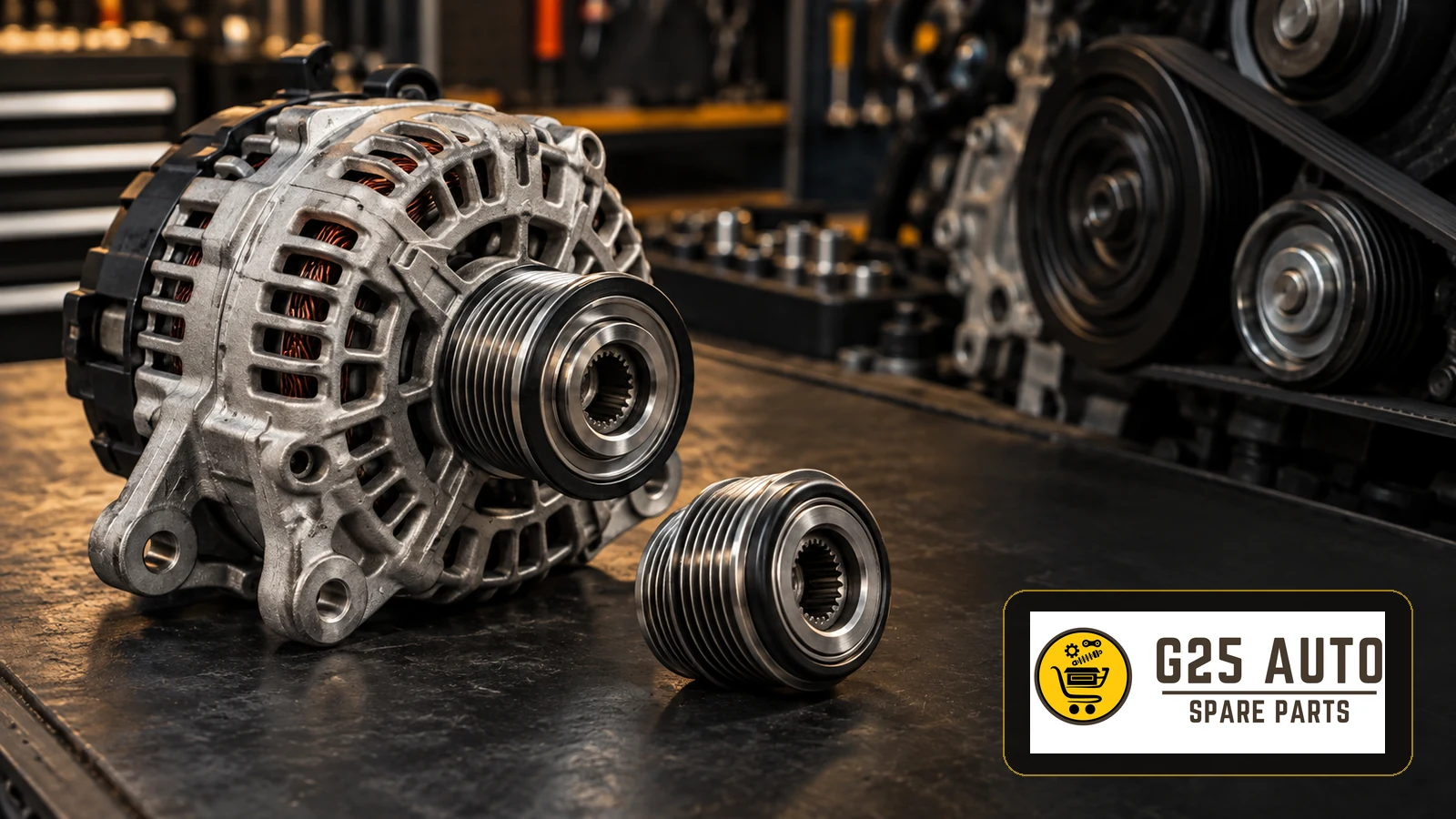
An alternator overrunning pulley allows the alternator rotor to continue turning briefly when engine speed drops, reducing belt vibration and load changes. A worn or seized pulley can contribute to belt noise, tensioner movement and charging-system complaints, but these symptoms must be diagnosed before parts are replaced.
How the overrunning pulley works
The auxiliary belt transfers crankshaft rotation to the alternator. Unlike a solid pulley, an overrunning design contains a one-way mechanism that can isolate part of the alternator rotor’s inertia during rapid deceleration. Some vehicles use an overrunning alternator pulley, while others use a decoupler with additional damping. These designs are not automatically interchangeable.
The correct pulley type forms part of the complete belt-drive system. Its operation affects the belt, tensioner and other driven accessories, so a problem should not be assessed as an isolated noise source.
Possible warning signs
Common observations include rattling or chirping around the belt drive, unusually large tensioner movement, belt flutter, vibration during engine-speed changes or visible pulley damage. A battery warning light or unstable charging may occur when the alternator cannot be driven correctly, but it does not prove that the pulley is the cause.
Similar symptoms can result from a worn belt, tensioner, idler, alternator bearing, crankshaft pulley or alignment problem. Continuing to drive with severe belt noise or damage may lead to loss of belt-driven functions.
Professional diagnosis
Diagnosis should begin with a visual inspection of the complete belt path and a review of the complaint under controlled conditions. After safe removal of the belt or alternator, a technician can test the pulley mechanism using the appropriate holding tool and the manufacturer’s procedure. Charging output and alternator condition should also be checked.
- Inspect the belt, tensioner and idlers together.
- Confirm whether the installed unit is a solid pulley, overrunning pulley or decoupler.
- Check for contamination, misalignment and mechanical damage.
- Use vehicle-specific service information and suitable tools.
Selecting and installing the correct part
Match the replacement using the vehicle VIN, OE reference, engine code, production date and the exact alternator model. Pulley diameter, groove arrangement, offset, thread and internal mechanism must correspond to the application. Visual similarity alone is not sufficient.
Before ordering through g25auto.com, provide the OE number and vehicle details for verification. Installation should be performed with the specified tool and tightening procedure. The belt system must be rechecked after assembly; impact tools or uncontrolled clamping can damage the new pulley or alternator shaft.
Frequently asked questions
Can a solid pulley replace an overrunning pulley?
Only when the vehicle manufacturer explicitly specifies that conversion. Changing the designed pulley type can increase vibration and belt-system loads.
Does belt noise always mean the pulley has failed?
No. Belt wear, tensioner faults, alignment and other bearings can produce similar noise. Diagnosis should cover the entire drive system.
Should the belt be replaced at the same time?
The belt should be inspected and replaced when worn, contaminated or damaged. Replacement decisions should follow its condition and vehicle-specific service guidance.